 Eleanora R.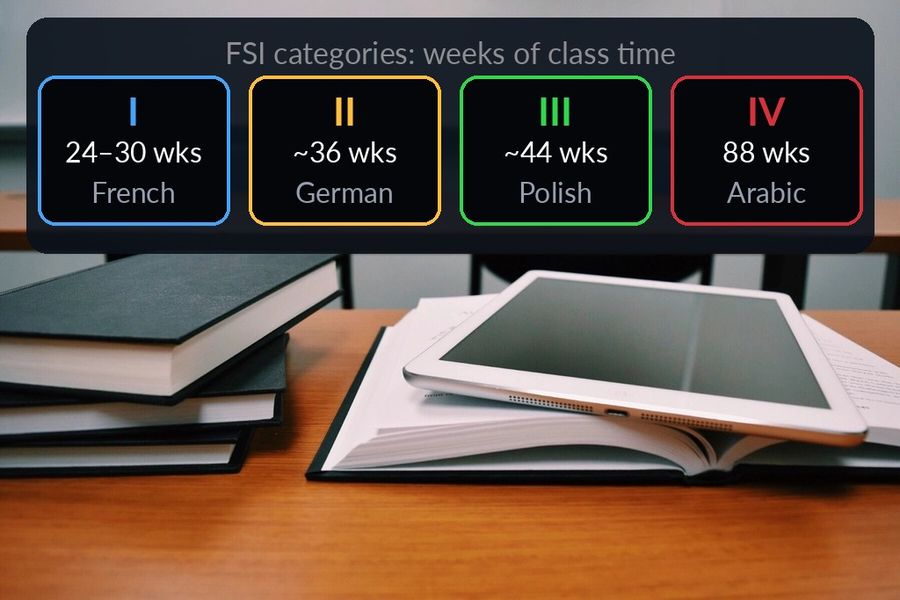
If you already speak English, some languages are simply less work than others — not because they are harder in any absolute sense, but because less of what you already know carries over. The US Foreign Service Institute, which trains American diplomats, sorts the languages it teaches into four categories by how many weeks of full-time class most English speakers need to reach professional working proficiency. Mandarin, Japanese, Korean and Arabic sit at the far end, needing roughly four times the class time of French, Italian, Spanish or Dutch. Where a language you are learning actually falls, though, depends on what you already speak — the part a fixed list cannot capture and a calculator can.
Key takeaways
- The FSI sorts languages into four categories: Category I (French, Spanish, Dutch) takes 24-30 weeks, while Arabic, Mandarin, Japanese and Korean take 88.
- Difficulty comes from grammar distance, a new script and little shared vocabulary with English, so a different script is worth learning first.
- The FSI list assumes a monolingual English speaker; languages you already speak change the estimate, which a calculator can adjust.
How the Foreign Service Institute measures difficulty
The Foreign Service Institute (FSI) trains US government staff who need a language for their posting, and after decades of full-time classroom courses it has a fairly precise record of how long each one takes. Its Foreign Language Training page groups the languages it teaches into four categories, timed to reaching a working proficiency score in speaking and reading — roughly the level needed to do a job in the language, not just get by in it. The clock counts only structured class time with an instructor, for groups of native English speakers with no relevant background, which is a narrower measure than "how long will it take me" but a far more consistent one than any single learner's story.
The four categories
Category I holds the languages closest to English in grammar and vocabulary: French, Italian, Spanish, Portuguese, Dutch, Swedish, Norwegian and Danish. Category II is a small step up — currently just German and Indonesian among the app's languages. Category III covers most of the rest: Greek, Polish, Turkish, Ukrainian, Hindi, Vietnamese, Finnish, Bengali and Thai. Category IV is reserved for the four languages the FSI calls "exceptionally difficult" for English speakers: Arabic, Mandarin, Japanese and Korean.
| Category | Full-time class | Example languages |
|---|---|---|
| I | 24–30 weeks (552–690 class hours) | French, Italian, Spanish, Portuguese, Dutch, Swedish |
| II | About 36 weeks (828 class hours) | German, Indonesian |
| III | About 44 weeks (1,012 class hours) | Greek, Polish, Turkish, Ukrainian, Hindi, Vietnamese |
| IV | 88 weeks (2,200 class hours) | Arabic, Mandarin, Japanese, Korean |
Our own language-timeline calculator uses these same four categories, and its full table lists every learning language the app supports against them, with a self-study estimate rather than a classroom one.
What actually makes a language hard
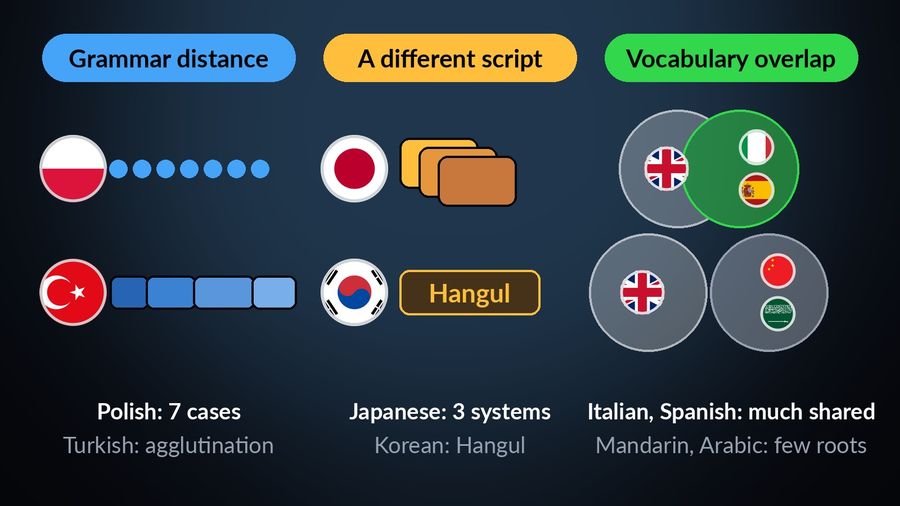
Three things drive the FSI's rankings, and they explain why the list looks the way it does. Grammar distance is the biggest one: Polish's seven noun cases, Turkish's agglutination and Ukrainian's vocative case all require rebuilding habits English never asks for. A different script adds a second, separate task before vocabulary can even begin: Japanese runs three writing systems at once, Korean's Hangul has to be learned before much else sticks, and Greek's alphabet is close enough to Latin letters to mislead you before it helps you. And vocabulary overlap does a lot of quiet work: English borrowed so heavily from French and Latin that a beginner in Italian or Spanish already half-recognises thousands of words, while Mandarin and Arabic share almost no roots with English at all.
Why the FSI list is not necessarily your list
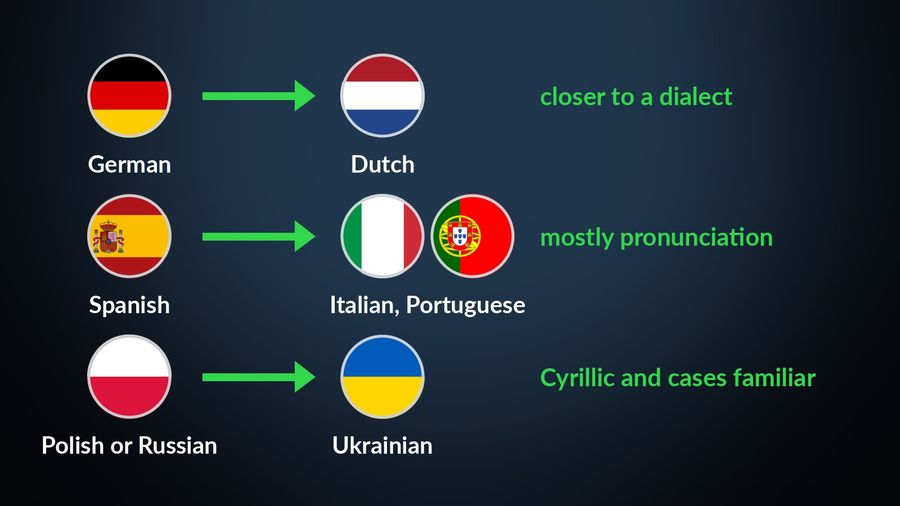
The FSI's categories describe a monolingual English speaker starting from zero, which very few learners actually are. If you already speak German, Dutch is closer to a dialect than a foreign grammar. If you speak Spanish, Portuguese or Italian is mostly a matter of adjusting pronunciation and a few hundred false friends. If you speak Polish or Russian, Ukrainian's Cyrillic and cases stop being new problems and become mostly familiar ones. None of that shows up in a category built around one fixed starting point.
Our language-timeline calculator takes this into account: pick the language you want to learn, tell it which languages you already speak, and it adjusts the FSI-based estimate for a close relative you already know, for vocabulary the target language borrowed from one of your languages, and a smaller allowance for every extra language behind you. The method is shown in full on the page, so you can see exactly what it is and is not counting.
Preparing for a Category III or IV language
The FSI's weeks assume a classroom and an instructor, which most learners do not have, but the order of operations still holds outside one. For a language with its own script — Japanese, Korean, Hindi, Arabic, Greek, Mandarin — reading comes before vocabulary sticks, so the writing system is worth learning first rather than picking up as you go. For a language with heavy grammar but a familiar alphabet, such as Polish or Turkish, vocabulary can run ahead of grammar without causing much confusion, since recognising a word does not require knowing which of its several forms you are looking at.
In both cases, vocabulary benefits from spaced repetition as much as a hard language benefits from any other single technique: a word you have not reviewed in the right window is a word you will look up again, and a Category IV language gives you far more words to lose track of than a Category I one. Passive exposure will not teach you Polish's cases or Japanese's grammar, but it is a reasonable way to keep the vocabulary from draining out from under the grammar work you are doing elsewhere.
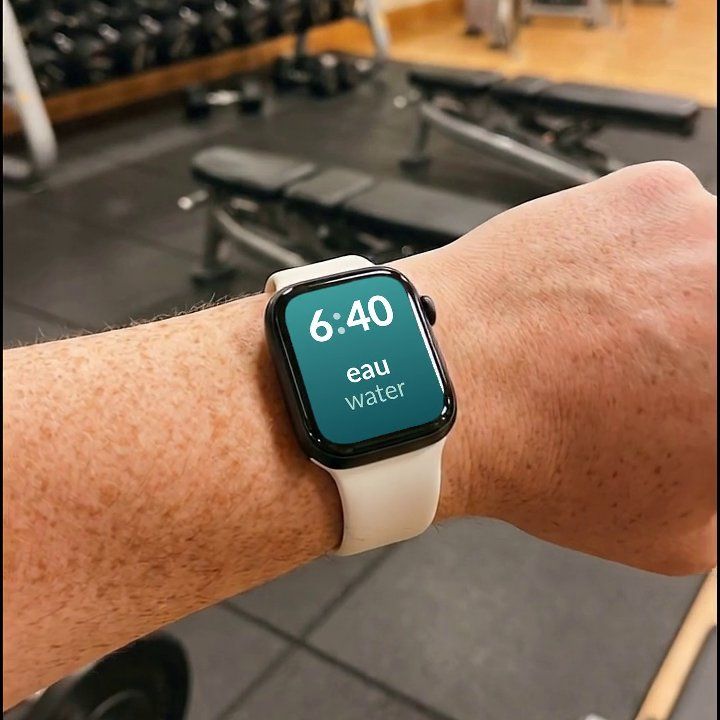

Watch Your Language schedules the vocabulary side of this with spaced repetition, showing each word again when you are close to forgetting it rather than on a fixed timer, on your iPhone's widgets and your Apple Watch face. For languages with a non-Latin script — Japanese, Korean, Arabic, Greek and others among its 25+ languages — the app shows transliteration alongside the word, so reading the script is not a prerequisite for building recognition. It does not teach grammar or speaking, which for a Category III or IV language is real work best done elsewhere.