
 Eleanora R.
Vietnamese looks reassuring on the page, because it is written in the Latin alphabet rather than a separate script. That reassurance runs out the moment you hear it spoken. Vietnamese is a tonal language: the pitch a syllable is said with is not an accent or a flourish, it is part of the word, marked in the spelling by a small sign above or below a vowel. Say the right consonants and vowels with the wrong tone and, more often than not, you have said a different word. The good news is that the marks are right there on the page, printed for every learner to see, which makes tone the one part of Vietnamese pronunciation you never have to guess at from an untoned spelling the way you sometimes do in Mandarin.
Key takeaways
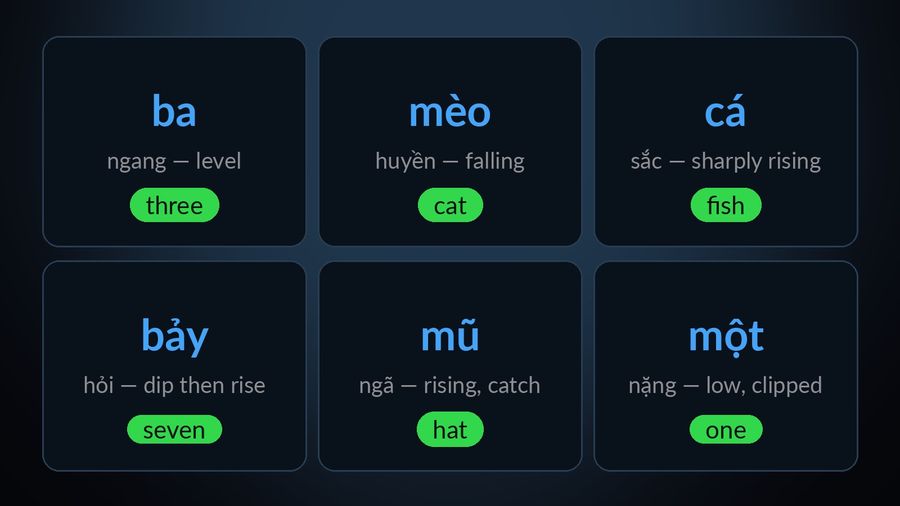
- Vietnamese has six tones marked in the spelling, so the right sounds with the wrong tone usually give a different word (ba, mèo, cá, bảy, mũ, một).
- Hỏi and ngã are the hardest to tell apart, and in Southern speech they merge, so recordings may differ from a Hanoi-standard textbook.
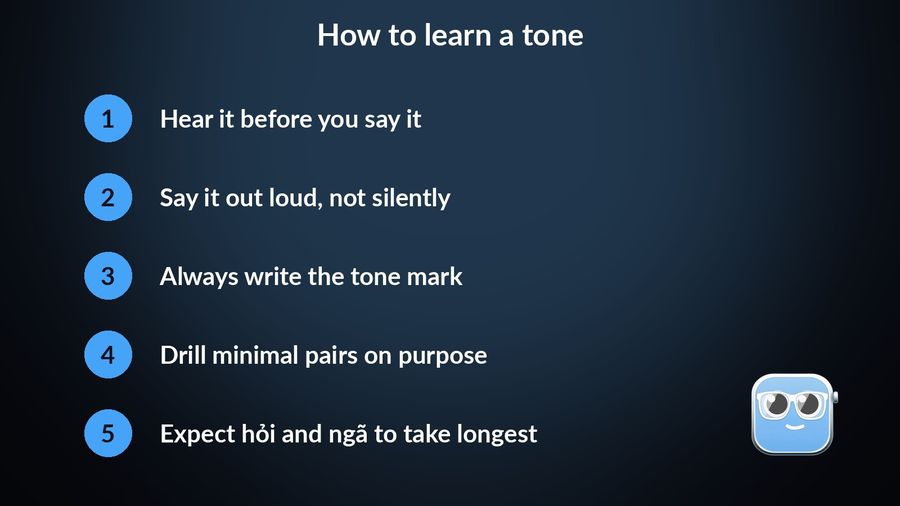
- Hear the word before saying it, say it aloud, always keep the tone mark, and drill minimal pairs; tone comes from listening, not charts.
Six ordinary words, six different tones
Textbooks usually introduce Vietnamese tone with the syllable ma, which can mean ghost, mother, but, horse, grave or rice seedling depending on which of the six tones carries it — a compact way of showing that tone changes meaning, not just delivery (Wikipedia, Vietnamese phonology). You do not need an invented syllable to see the same point. Six everyday words, each carrying one tone, make it just as clearly: ba (three) said level, mèo (cat) said falling, cá (fish) said sharply rising, bảy (seven) said dipping then rising, mũ (hat) said rising with a slight catch, and một (one) said low and clipped. Six different meanings, six different spellings — and the only thing that tells a reader which is which, in each case, is the small mark above or below the vowel.
The six tones, one at a time
Standard Vietnamese pronunciation, as taught and as spoken in Hanoi, distinguishes six tones: ngang, level and unmarked, the plain pitch a syllable defaults to; huyền, marked with a grave accent, a low fall; sắc, marked with an acute accent, a rise from mid to high; hỏi, marked with a hook, a dip followed by a rise; ngã, marked with a tilde, a rise interrupted by a brief catch in the throat; and nặng, marked with a dot under the vowel, a short, low, clipped fall (Wikipedia, Vietnamese phonology). Two of those six, hỏi and ngã, are the pair most beginners struggle to tell apart by ear, since both start with a dip — the difference is that catch in the throat on ngã, which is easier to hear once you know to listen for it than to describe in words.
Why the tone you hear can depend on where you are
The six-tone system above is the Hanoi standard, the one most courses and dictionaries teach. Spoken Vietnamese varies by region the way any widely spoken language does, and the tone system is one of the places that shows. In Southern Vietnamese speech, centred on Ho Chi Minh City, the hỏi and ngã tones merge into a single dipping-rising tone, so a Southern speaker's ear is doing five-way work where a Northern one is doing six (Wikipedia, Vietnamese phonology). The spelling does not change — bảy and a ngã-toned word are still written with their own separate marks everywhere in the country — only the spoken distinction narrows. It is worth knowing this exists before you conclude that a recording you hear does not match what a textbook told you: both can be right, for a different city.
How to actually learn a tone
None of this is memorised from a description the way you might memorise a grammar rule. Tone is a sound, and sounds are learned by ear before they are learned by explanation.
- Hear the word before you say it. Listen to a native recording first, every time, for a new word — guessing a tone from the mark alone and correcting it later is possible, but it is slower than getting it right from the start.
- Say it out loud against the recording, not silently. Tone is a physical habit in your throat and pitch as much as a mental one. Silent reading does not build it.
- Write the tone mark every time, never the bare vowel. A romanisation with the marks stripped off, which you will sometimes see on menus or in casual typing, is missing the part of the word that carries meaning. Always practise from the fully marked spelling.
- Drill minimal pairs on purpose. Pick two words that differ only in tone — ba and bà (“three” and “grandmother” style pairs are everywhere in Vietnamese) — and listen to them back to back until the difference stops sounding subtle.
- Expect the dip-tones to take longest. Hỏi and ngã are the two most learners keep confusing after weeks of study elsewhere. Slowing down and exaggerating the throat catch on ngã while practising is a normal, useful crutch early on.
Tone is a habit, not a wall
Learners who have been through it describe the same arc: the six tones feel like an impossible extra layer for the first few weeks, and then, somewhere past that point, your ear starts doing the sorting on its own, the way an English learner eventually stops consciously separating “ship” from “sheep”. Nothing about that process is sped up by studying the tone chart harder. It comes from hours of listening and speaking, the same way the rest of pronunciation does, in any language. Keep the marks in the spelling, get the sound from a recording or a speaker rather than from the letters, and treat the early weeks of mixing up hỏi and ngã as normal rather than as a sign you are doing something wrong.
Vietnamese is not the only language that puts more of its meaning into pitch than English speakers expect: see how the same idea plays out in Mandarin's four tones. To get a rough sense of how long the vocabulary side of Vietnamese takes, try the how long to learn Vietnamese calculator, and to see how many Vietnamese words you already recognise, the Vietnamese vocabulary test gives a quick read. For more on how a schedule built around the words you keep forgetting works in general, see spaced repetition, explained.


Watch Your Language shows Vietnamese vocabulary with its tone marks intact on your iPhone Lock Screen and Apple Watch face, a few words at a time, on a schedule built around the words you keep forgetting. What it will not do is teach you the tone itself: it is a passive vocabulary tool, not a pronunciation course, so the written word here is a hook for a sound you learn from listening elsewhere — never a substitute for hearing it.