 Paul L.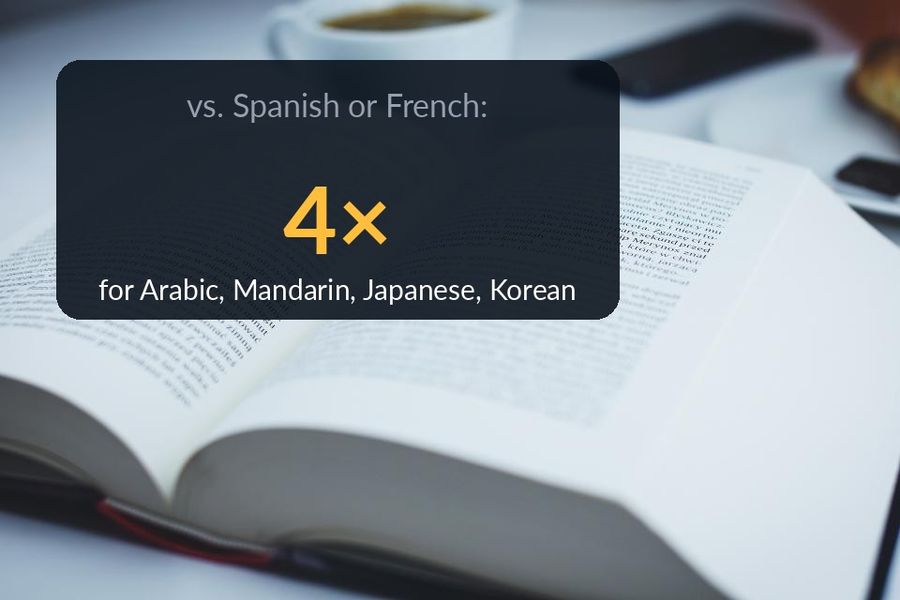
The honest answer is: it depends on the language and on how fluent you need to be, but two published sources give real numbers instead of a guess. Plug your own language, level and weekly hours into our free calculator for a specific estimate. For a quick sense of the range: reaching a professional level in a close relative of English, such as Spanish or French, runs to roughly 550–690 class hours. Arabic, Mandarin, Japanese or Korean take close to four times that.
Those figures come from the two sources behind the calculator, and each measures something a little different. Knowing which one you are looking at, and what it leaves out, matters more than the number itself.
What the Foreign Service Institute measures
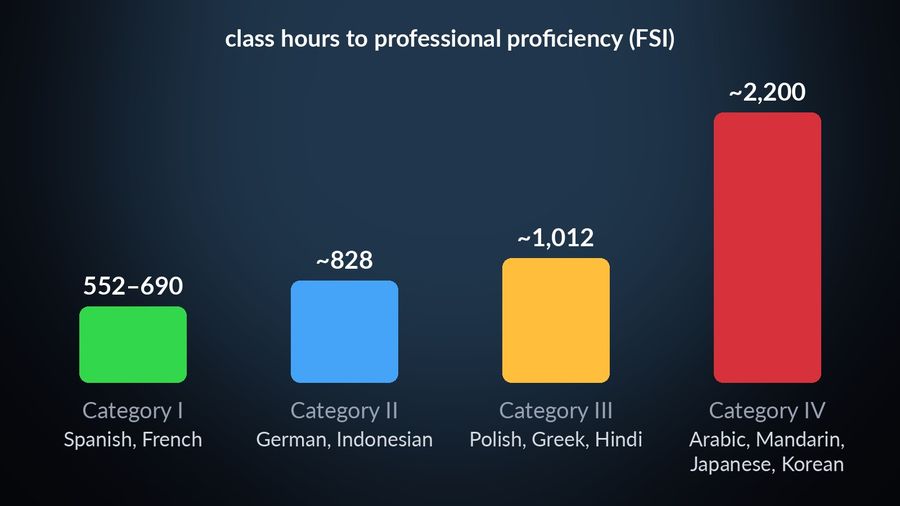
The US Foreign Service Institute trains American diplomats, and groups the languages it teaches into four categories by how many weeks of full-time class a native English speaker needs to reach professional working proficiency:
- Category I — 24–30 weeks, 552–690 class hours. Spanish, French and similarly close relatives of English.
- Category II — 36 weeks, about 828 class hours. German, Indonesian.
- Category III — 44 weeks, about 1,012 class hours. Polish, Greek, Hindi, among others.
- Category IV — 88 weeks, about 2,200 class hours. Arabic, Mandarin, Japanese, Korean.
Read those hours carefully before borrowing them for your own plan. They are full-time: a diplomat in Category I training sits in class about five hours a day, five days a week, for six or seven months. They assume a native English speaker starting from zero. And "professional working proficiency" is a high bar — enough to work in the language, not enough to pass as a native speaker, but well past being able to order dinner or ask for directions.
What Cambridge's guided learning hours measure
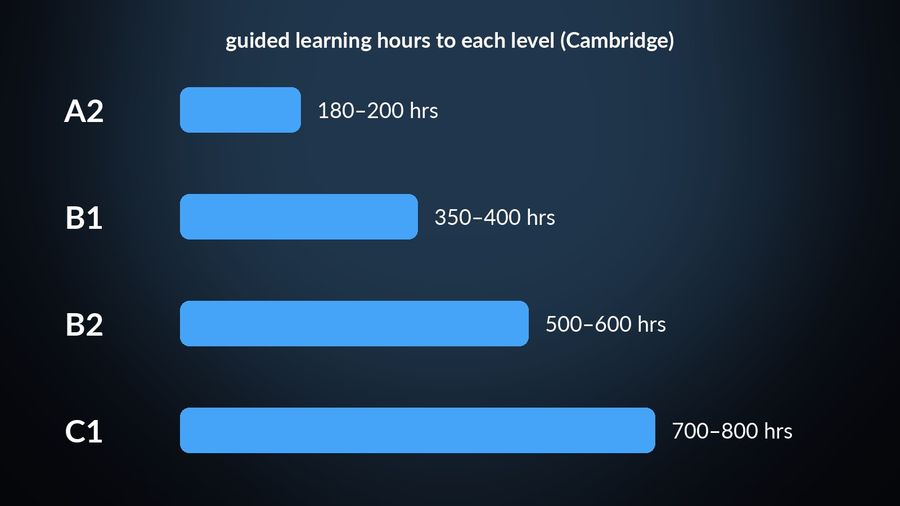
Cambridge English publishes a different figure: the cumulative guided learning hours a learner typically needs, starting from zero, to reach each level of the Common European Framework (CEFR):
- A2: 180–200 hours
- B1: 350–400 hours
- B2: 500–600 hours
- C1: 700–800 hours
Cambridge also lists 90–100 hours for A1, but that figure comes from its exams for young learners, so the adult estimates here start at A2. These hours were measured for people learning English, and "guided" means the same thing FSI's hours mean: time with a teacher, in a classroom or an equivalent course, not including homework or the practice you do on your own. For most people this is the more useful figure, because it answers the question in the terms people actually think in — "I want to reach B1" — rather than in weeks of diplomatic training.
What changes the number for you
Both figures are averages for a hypothetical learner who does not exist. Four things move the real number up or down.
Languages you already speak
FSI's categories were built around native English speakers, so they assume no head start. If you already speak a close relative of the language you are learning, that assumption does not hold: Ukrainian or Russian narrows the distance to Polish the same way French or Italian narrows it to Spanish. Shared vocabulary helps even between languages that are not close relatives — Polish absorbed a good number of French words over the centuries, so a French speaker learning Polish recognises some vocabulary on sight that an English speaker has to learn from nothing. Every other language you already speak tends to help a little too, since you are not learning how to learn a language for the first time.
Hours per week, and staying consistent
The total hours a level takes are roughly fixed; what changes is how many months they take to put in. Three hours a week and ten hours a week reach the same total on very different calendars. What the FSI hours do not capture well is that they assume near-daily class contact, not one long session followed by three silent weeks. Vocabulary in particular fades between sessions, which is the whole case for spacing contact out rather than clustering it — see our explanation of spaced repetition for why frequent, brief contact beats occasional long ones for retention.
What "learn" means for you
A2 and B2 sit roughly 300–400 hours apart on Cambridge's scale, so deciding what you actually need changes the estimate more than almost anything else. Ordering food, asking directions and following simple conversation sit close to A2. Reading a novel, following a work meeting or arguing your side of a disagreement sit much closer to B2 or C1. It is worth being specific about which one you are aiming for before you commit to a number of hours. If you already know some of the language, our free vocabulary level test gives you a rough CEFR starting point, so the hours ahead of you are counted from where you actually are rather than from zero.
Age
Age is the one variable to be careful with. Research broadly agrees that adults are efficient learners, especially early on, and that the hours you put in matter more than your age. It does not agree on a reliable rate of change per age band, so any specific adjustment for age is an allowance, not a measurement — including the one our own calculator applies. Treat it as a small, cautious nudge rather than a fact to plan around.
Turning the hours into a plan
Once you know roughly how many hours a level takes, the planning question becomes simple arithmetic: hours needed, divided by hours a week you can realistically keep up, equals months. "Realistically" is doing the work in that sentence — a number you can sustain for a year beats a higher number you abandon in March. Our Japanese and Spanish calculator pages (and the others for each of the app's languages) run this math for a specific language, level and weekly commitment, and show the two figures above so you can check the working.
It is also worth separating what these hours are for. Both FSI and Cambridge count time in active study — a class, a course, structured practice with a teacher. That is where grammar, speaking and listening are actually taught, and nothing passive replaces it; we have written honestly about the limits of exposure alone in Does Passive Learning Work? Vocabulary retention is the piece that benefits most from being spread across the day instead of packed into the class hours, since a word needs to be met several times, spaced out, to stick — which is a habit that runs alongside a study plan, not a replacement for one.
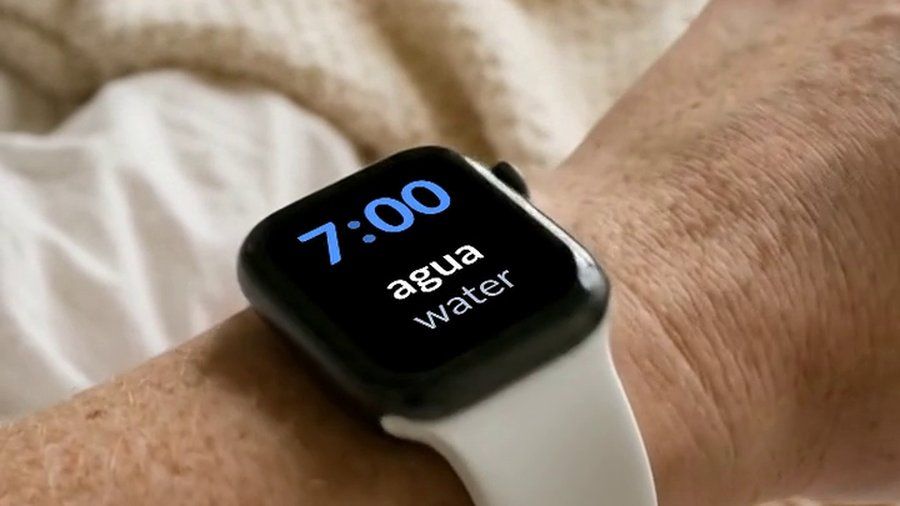

Watch Your Language is built for the vocabulary side of that plan, not the class-hour side. It shows the words you are learning in widgets on your iPhone Lock Screen and Home Screen and in complications on your Apple Watch face, scheduling the ones you keep forgetting to come back more often. Packs are graded from A1 to C2 across 25+ languages, so you can match the words to the level you are aiming for, and add your own from a photo, a spreadsheet or typed in as you go.
What to take away
There is no single honest number for "how long does it take to learn a language", because the question hides three others: which language, starting from where, to what level. The FSI categories and Cambridge's guided learning hours answer those three questions reasonably well for a generic learner. What already narrows the gap for you — the languages you speak, the hours you can actually keep up, and the level you are really aiming for — is worth a few minutes of honest thought before you commit to a plan, and the calculator above does the arithmetic once you have.