 Eleanora R.
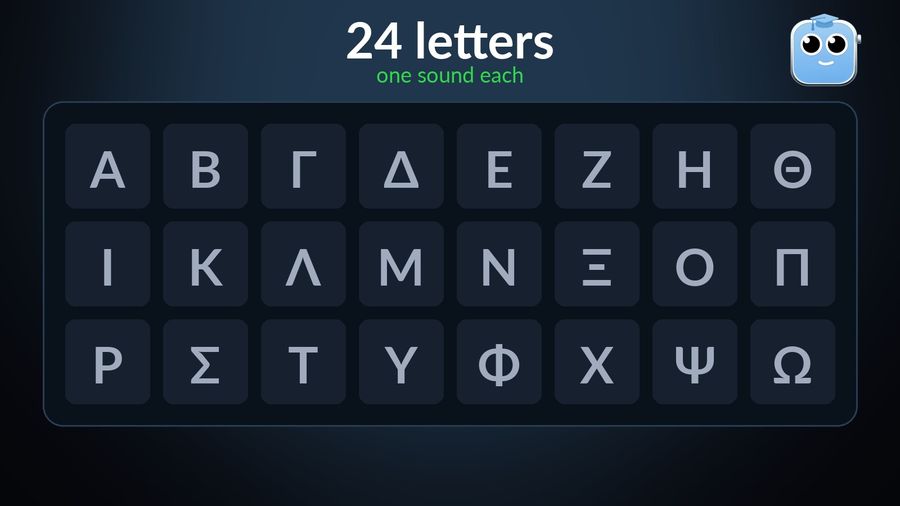
Open a Greek menu, a street sign, or a page with a few equations on it, and an English speaker who has never studied a word of Greek can already pick out familiar shapes. Π, Σ, Δ, Θ, Λ and Ω, and the lower-case α, β, γ and μ, turn up constantly in school maths and physics — pi, sigma for a sum, delta for a change, theta for an angle, omega for resistance, alpha and beta for radiation, mu for micro-. That head start is real. It is also narrower than it feels, because those symbols entered English as borrowed shapes, not as sounds. They tell you what a letter looks like, not what it says when a Greek speaker uses it, and that gap between shape and sound is where the actual work of the Greek alphabet lives.
Key takeaways
- Greek is a true alphabet of twenty-four letters, so you can sound out unfamiliar words within days once you know each sound.
- Familiar shapes mislead: beta is pronounced v, and B, D and G sounds are written with letter pairs such as μπ, ντ and γκ.
- Reading is quick but spelling is hard, because several different letters and digraphs share one sound; treat accent marks as pronunciation information.
An alphabet, not a puzzle: reading comes quickly
Greek is a true alphabet, twenty-four letters, each standing for a sound, combined the way English letters are. That puts it in a different category from a writing system built on thousands of individual characters. Learn the twenty-four letters properly, not just their names but the sound each one makes, and you can sound out an unfamiliar Greek word correctly within days. The catch is that sounding a word out correctly and knowing what you are looking at are two different skills, and the alphabet on its own only gives you the first.
The letters that don't mean what they look like
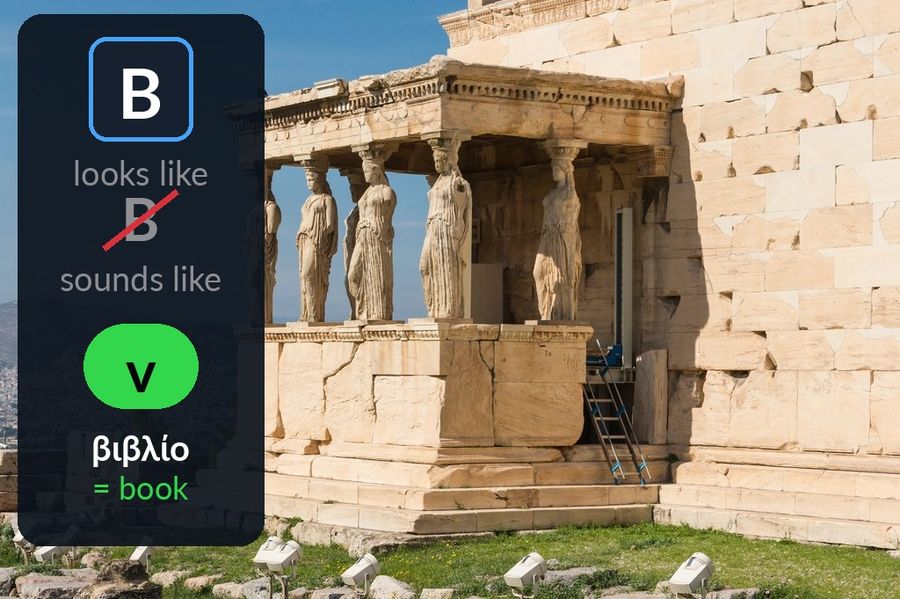
This is where the maths-and-science head start misleads rather than helps: it primes an English speaker to expect Latin sound values, and several of the most common Greek letters don't have them. Β looks like a capital B and is pronounced v — βιβλιο (vivlio, "book") starts with the sound in "van", not "boy". Δ is not "d"; its lower case, δ, makes the sound at the start of "this". Γ is softer still, somewhere between a "y" and a gargled "g", with no real English equivalent.
Because β, δ and γ were reassigned to these sounds long ago, Modern Greek writes the sounds an English speaker actually expects from B, D and G with pairs of letters instead: μπ, ντ and γκ. Order a tomato and you get ντοματα (domata) — ντ, not δ, for that "d". A bathroom is μπανιο (banio) — μπ, not β, for that "b". The word for tree, δέντρο (dendro), uses both patterns at once: δ for "th", ντ for "d". None of this is irregular. It is a consistent system, and it is the opposite of the one the letter shapes suggest to someone arriving from algebra class.
One sound, several correct spellings
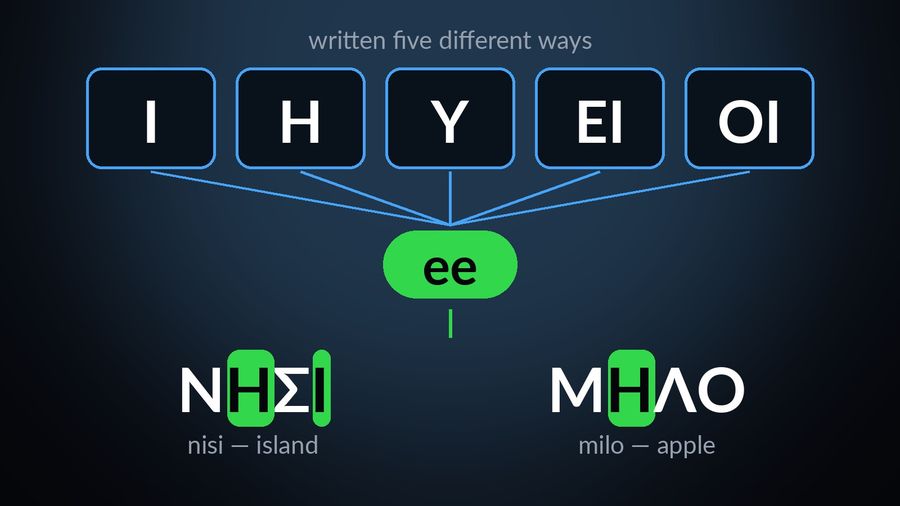
The mismatch runs the other way too, and this is the one that makes Modern Greek genuinely hard to write rather than hard to read. Several letters and letter pairs that look nothing alike are pronounced identically. Ι, Η and Υ, and the digraphs ει and οι, are all pronounced like the "ee" in "see" — a merger that happened gradually, over the language's history, long after the spelling had already settled. So νησί (nisi, "island") and μήλο (milo, "apple") share that same "ee" sound, spelled with a different letter each time, for no reason you can hear. αι is pronounced like the "e" in "pet" — και (ke, "and"), one of the most common words in the language, gives no visual hint of how short and flat it actually sounds. ου is pronounced "oo", which English already knows from a word Greek exported rather than the other way round: ouzo is spelled exactly the way it sounds.
Put the two problems together and the shape of the difficulty is clear. Reading Greek aloud from the page is a skill you can build fast, because every letter has one sound. Writing Greek correctly from what you hear is a much slower skill, because plenty of sounds have four or five possible spellings, and only familiarity with the specific word tells you which one is right — a problem Greek schoolchildren spend years on, not only learners.
The accent that does you a favour
One feature of written Greek actually makes life easier, and English has nothing quite like it: every word of two or more syllables carries a written accent, the τόνοσ, marking exactly which syllable to stress. This is not decoration. Stress is phonemic in Greek, meaning moving it changes the word: πότε (póte), stressed on the first syllable, means "when"; ποτέ (poté), stressed on the second, means "never". A learner reading French or German has to absorb stress by ear, over time. A learner reading Greek is told, in the text itself, on every single word.
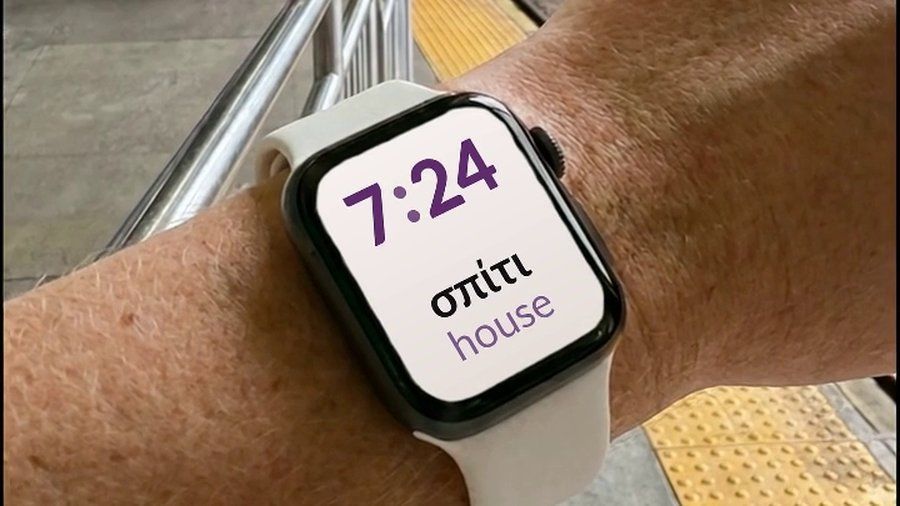

Watch Your Language shows Greek vocabulary with its romanisation alongside the script — βιβλιο (vivlio) rather than the Greek on its own — in a widget on your iPhone Lock Screen and Apple Watch face, a few words at a time. That pairing earns its keep for exactly the mismatch above: it lets you attach the right sound to a word before reading the script fluently is second nature.
Where to actually spend the first weeks
Learn the twenty-four letters and their sounds properly, digraphs included, before worrying about anything else. It is a few days' work and it unlocks every menu, sign and word list you meet afterwards. Do not expect that to make spelling easy, because it won't — not for you, and not for fluent adult native speakers either, since the language genuinely offers several correct-looking ways to write the same sound. Read the accent marks as information rather than clutter: they are quietly doing the job a pronunciation guide does in a dictionary, on every word, for free.