 Eleanora R.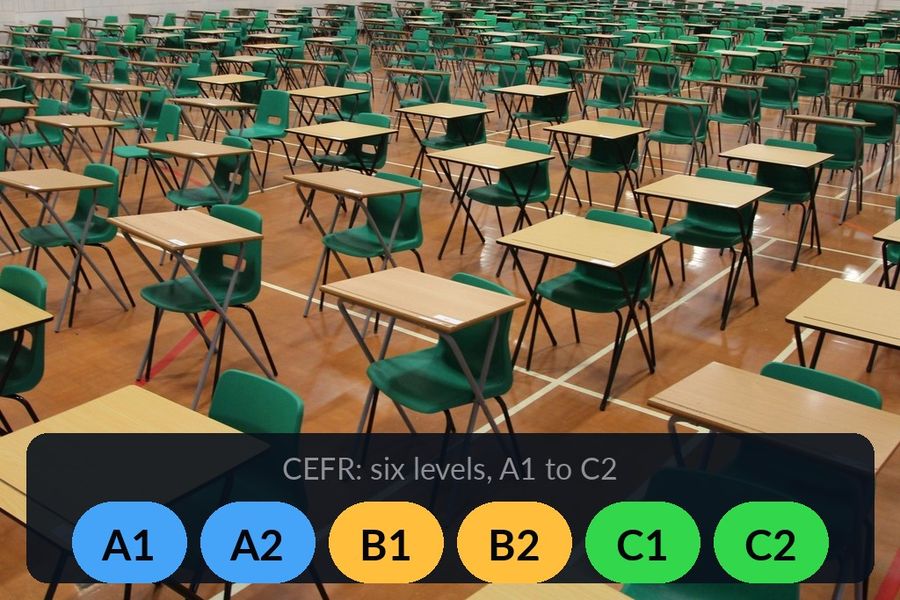
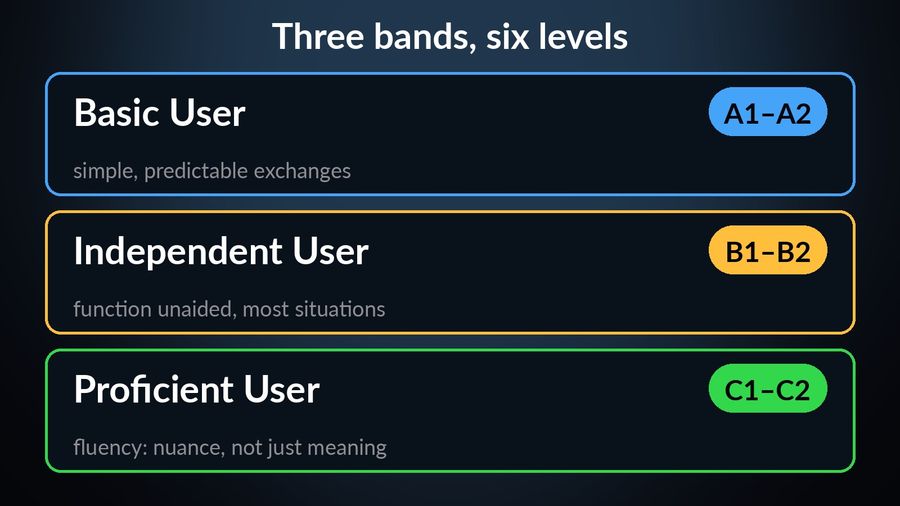
CEFR stands for the Common European Framework of Reference for Languages, and its six levels — A1, A2, B1, B2, C1, C2 — are the scale that course books, language schools and most vocabulary apps quietly organise themselves around. The letters group into three bands: A is a Basic User, B is an Independent User, C is a Proficient User. Each number within a band is a further step: A1 is the very start, C2 is close to a highly educated native speaker's command of the language. If you already know a little of a language and want a starting point rather than a definition, our free vocabulary level test gives you a CEFR estimate in about three minutes.
What follows is the plain-language version of what each level lets you actually do, based on the Council of Europe's own CEFR framework, which publishes a "global scale" description for each level. The wording below is a plain-English paraphrase of that scale, not a quotation.
The three bands, in one line each
Basic User (A1–A2) covers simple, predictable exchanges about things you can point to: yourself, your family, shopping, directions. Independent User (B1–B2) is where you can function unaided in most everyday and work situations, without needing the other person to slow down or simplify. Proficient User (C1–C2) is fluency in the ordinary sense of the word: reading dense material, following fast conversation, and expressing nuance rather than just meaning.
The six levels, one at a time
A1 — Beginner
You can understand and use very basic everyday phrases, introduce yourself, and ask or answer simple questions about where you live or people you know. You can hold a simple exchange, but only if the other person speaks slowly and is willing to help you along.
A2 — Elementary
You can understand sentences and common expressions about things that matter to you directly — basic personal and family information, shopping, local geography, your job. You can manage short, routine exchanges that call for a simple, direct swap of information, and describe your background and immediate surroundings in plain terms.
B1 — Intermediate
You can follow the main points of clear, standard speech on familiar subjects — work, school, leisure — and handle most situations that come up while travelling in the language. You can write connected text on familiar topics, and describe experiences, events, hopes and plans, giving brief reasons for an opinion.
B2 — Upper-Intermediate
You can follow the main ideas of complex text on both concrete and abstract subjects, including a technical discussion in a field you know. Conversation with a native speaker is possible without strain on either side, and you can produce clear, detailed writing on a wide range of subjects.
C1 — Advanced
You can follow long, demanding text and pick up on meaning that is implied rather than stated outright. You express yourself fluently and spontaneously, rarely searching for a word, and can use the language flexibly across social, academic and professional settings.
C2 — Mastery
You can understand with ease virtually anything you hear or read, summarise several spoken and written sources into a coherent whole, and express yourself spontaneously and precisely enough to convey fine shades of meaning even in a complicated situation.
What each level typically takes
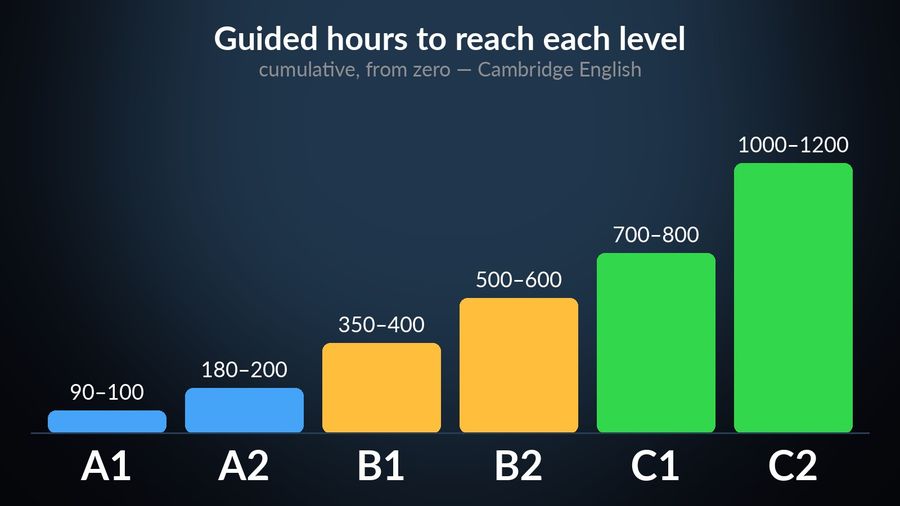
Levels are not evenly spaced. Reaching A2 from nothing takes far fewer hours than climbing from B2 to C1, mostly because the language itself gets denser as you go — more vocabulary, more exceptions, more of the nuance that C-level fluency depends on. Cambridge English publishes cumulative guided learning hours for reaching each level from zero — classroom or equivalent taught time, not including practice on your own. These were measured for English; treat them as a reasonable order of magnitude for a comparably distant language, not an exact figure for every language.
| Level | Band | What you can do | Typical guided hours |
|---|---|---|---|
| A1 | Basic User | Simple exchanges, with help from the other person | 90–100 (from its young learners’ exams) |
| A2 | Basic User | Everyday tasks: shopping, directions, basic forms | 180–200 |
| B1 | Independent User | Getting by while travelling; a routine conversation | 350–400 |
| B2 | Independent User | Following a work meeting; arguing a point of view | 500–600 |
| C1 | Proficient User | Working fluently; reading demanding text | 700–800 |
| C2 | Proficient User | Near-native precision, including nuance | 1,000–1,200 |
Our guide to how long a language takes goes further into where these hours come from and what changes them for you; the calculator behind it turns a level and a language into an estimate you can actually plan around.
How levels are tested
The CEFR itself is not an exam — it is the scale that language exams are pegged to. Most major languages have their own official certification, usually run by that country's government or a national institute, with a separate diploma per level or pair of levels. For French, the DELF and DALF diplomas cover A1 through C2 between them. For German, the Goethe-Institut's exams run the same range. For Spanish, the DELE diplomas, issued by the Instituto Cervantes, do the same. Passing one of these is a formal, internationally recognised confirmation of a level; nothing below replaces that if you need the diploma itself, for a university application or a job.
How to find your level without an exam
For everyday purposes — picking a course, choosing a book, deciding whether you are ready to try a show without subtitles — a formal exam is more than you need. A short vocabulary check gives a reasonable estimate: how many words you recognise, and at which level those words sit, tends to track your overall level closely enough to be useful. It will not catch everything a full exam does — grammar, listening, speaking and writing are each their own skill — but it is a fast, honest starting point, and a level you can revisit every few months to see whether it has moved.
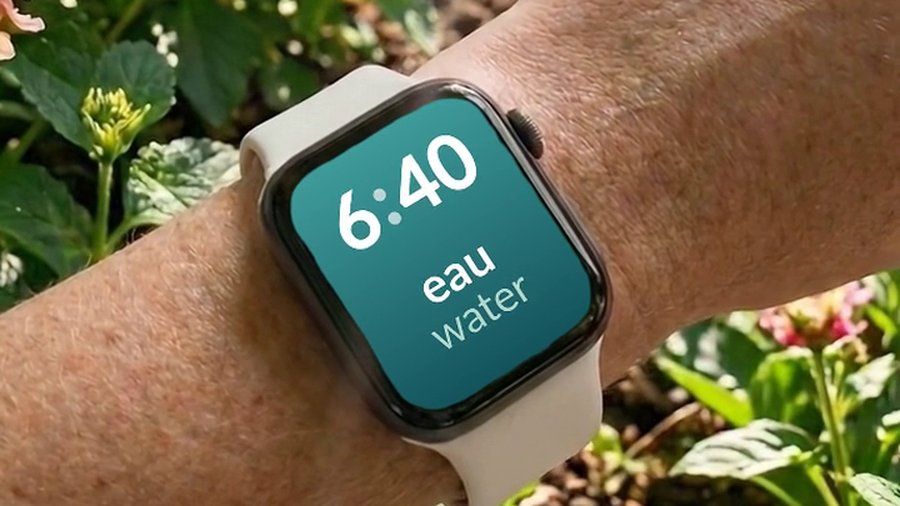

Watch Your Language is a vocabulary tool, not an exam or a grammar course, so it will not certify a CEFR level for you. What it does is organise its 10,000+ words into packs graded A1 through C2, the same scale used above, so once you have a rough level you can start at the packs that match it. The words then appear a few at a time on your iPhone Lock Screen and Home Screen and on your Apple Watch face, with the ones you keep forgetting brought back more often.
A reasonable way to use the scale
- Take a short vocabulary check to get a rough starting level rather than guessing.
- Pick learning material — a course, a pack, a book — labelled for that level or one step above it.
- Reserve the official exam for when you actually need the diploma, not as a routine progress check.
- Expect the higher levels to take disproportionately longer, and plan the hours accordingly rather than by the letter alone.