
You can learn a good deal of vocabulary without a study session — but not all of it, and not in the way the phrase usually promises. Repeated, brief contact with a word is enough to make it familiar and then recognisable. Being able to produce it in conversation still takes a little active work. The practical approach is to let unscheduled exposure do the bulk of the repetition, and keep the active part so small that it survives a busy week.
Why study sessions are the weak link
Most vocabulary methods are sound. Flashcards work, spaced repetition works, reading works. What fails is the appointment. A method that depends on you sitting down for twenty minutes a day inherits every reason you might not: a late meeting, a sick child, a week of travel. Miss a few days and the backlog that greets you is larger and less inviting than the one you left.
Vocabulary is also unusually sensitive to this, because it is learned by repetition over time rather than by understanding once. A grammar rule you have grasped stays grasped for a while. A word you met once, a week ago, is mostly gone. What vocabulary needs is not long sessions but frequent, spaced contact — which is exactly what a session-based routine is worst at delivering on a bad week.
What "without studying" can honestly deliver
Recognition
Seeing a word and its translation many times, spread across days, is how a word goes from unfamiliar to known-when-seen. This is the first stage of knowing any word, and it is the stage that most rewards low-effort, repeated contact. It is also most of what you need to begin reading.
Retention of what you already met
Words you learned in a class, a book or a conversation fade unless they come back. Passive review is an efficient way to keep bringing them back, because it costs you nothing to see a word you half-remember and be reminded.
What it cannot deliver
It will not, on its own, make you able to say the word under pressure, and it will not teach you how the word behaves in a sentence. Those come from reading, writing and speaking. We have written about these limits at more length in Does Passive Learning Work? An Honest Answer

Where the repetitions can come from
The idea is to attach vocabulary to things you already do many times a day, so the repetitions happen whether or not you feel like studying.
- The screens you already look at. Your phone's Lock Screen and your watch face are seen dozens of times a day, for a second or two at a time — about the right length for one word.
- The labels around you. Sticky notes on objects at home work for concrete nouns, although they stop being noticed after a week or two, so they need moving.
- Your phone's language settings. Switching the interface to the language you are learning teaches a narrow but useful vocabulary of menus and buttons, once you know where everything is.
- Audio in dead time. Podcasts and audio lessons during a commute or chores build listening; they are less efficient for specific words, because you cannot choose which ones come back.
Making the words come back at the right time
Exposure is only half of it. Which word you see matters too. Seeing words you already know well is pleasant and does little; seeing a word just as you were about to forget it is what makes it stick. That is the principle behind spaced repetition, explained in Spaced Repetition, Explained Without the Jargon. A good passive setup keeps that scheduling and drops the session: the words you are losing come round more often, and the ones you know fade into the background.
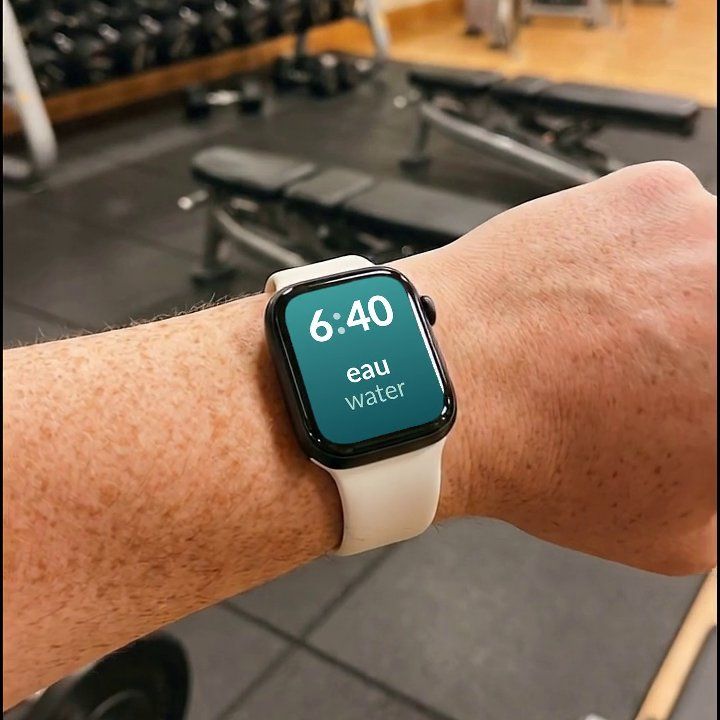

Watch Your Language is built for this. It shows your vocabulary in widgets on your iPhone Lock Screen and Home Screen and in complications on your Apple Watch face, and decides which word appears next based on which ones you are forgetting. You choose how often the word changes; there is no session to open and no backlog to clear.
A setup that survives a busy week
- Choose a small, relevant set. Twenty words you will meet this month beat two hundred from a generic list. If you are starting from nothing, the most common words are a sound first set — see our free Spanish, French and German vocabulary lists.
- Put them where you already look. One place you glance at constantly is worth more than several you rarely see.
- Keep one tiny active habit. Say each new word out loud once, or use it in one written sentence. A minute is enough, and it is the part passive exposure cannot do for you.
- Retire what you know. Once a word is automatic, take it out of rotation so the space goes to words that still need it.
- Add words you actually met. A word from a film, a menu or a conversation has a memory attached to it already, and sticks faster than one from a list.

What to expect
The first sign it is working is small: a word on a sign or in a subtitle that you recognise without trying. Recognition arrives first and production later, and the gap between them is normal rather than a sign that something is wrong. The advantage of learning this way is not speed on your best day. It is that your worst week no longer sets you back.