 Paul L.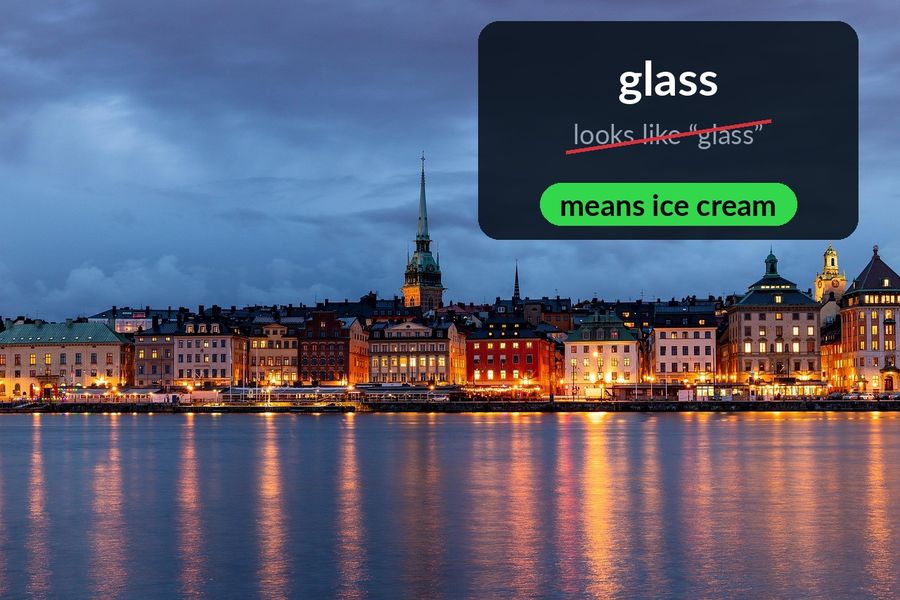
English and Swedish come from the same Germanic family, and a surprising amount of everyday Swedish vocabulary is readable on sight for an English speaker: hus is house, bok is book, vinter is winter, fisk is fish, vatten is water. That head start is real, but it comes with two catches: a handful of the words that look most familiar mean something else entirely, and English already borrowed a surprising number of Swedish's Norse relatives centuries ago, so some of the resemblance runs both ways.
A head start most learners do not get
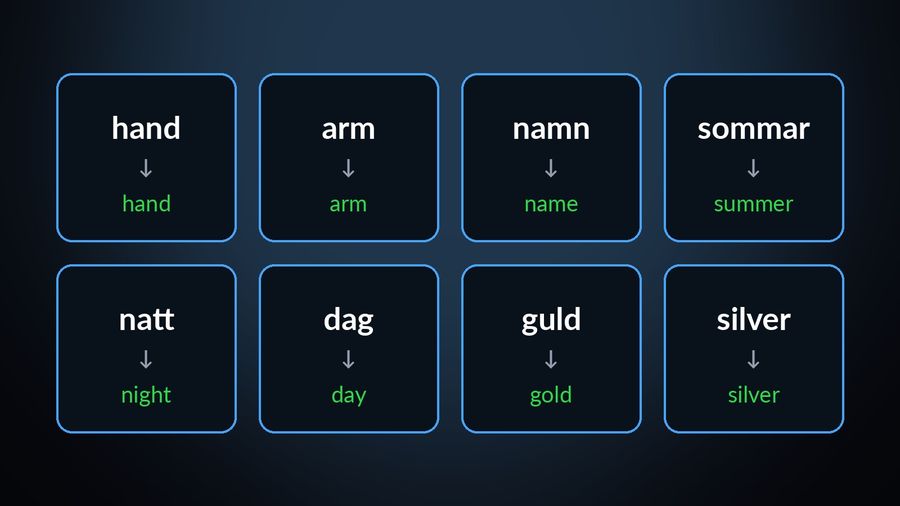
Swedish and English both descend from Proto-Germanic, and the family resemblance survived better in some corners of the vocabulary than others. Body parts, family words, and the oldest everyday nouns tend to be the clearest matches: hand is hand, arm is arm, namn is name, sommar is summer, natt is night, dag is close enough to day, guld to gold, silver stayed identical. A Swedish word list built for an English speaker is not starting from zero the way a Japanese or Arabic one would.
What the Vikings left behind in English
Some of that closeness runs in the other direction. Old Norse, the language Viking-Age settlers brought to parts of Britain, is the direct ancestor of Swedish, and it left a lasting mark on English itself: egg (Swedish ägg), knife (kniv), skin (skinn), wing (vinge), and even the pronouns they, them and their (de, dem, deras) came into English from Norse, replacing older native words. Learning Swedish vocabulary is not always meeting something new — sometimes it is meeting the word English took from the same source centuries ago, worn down slightly differently on each side.
Where the resemblance turns into a trap
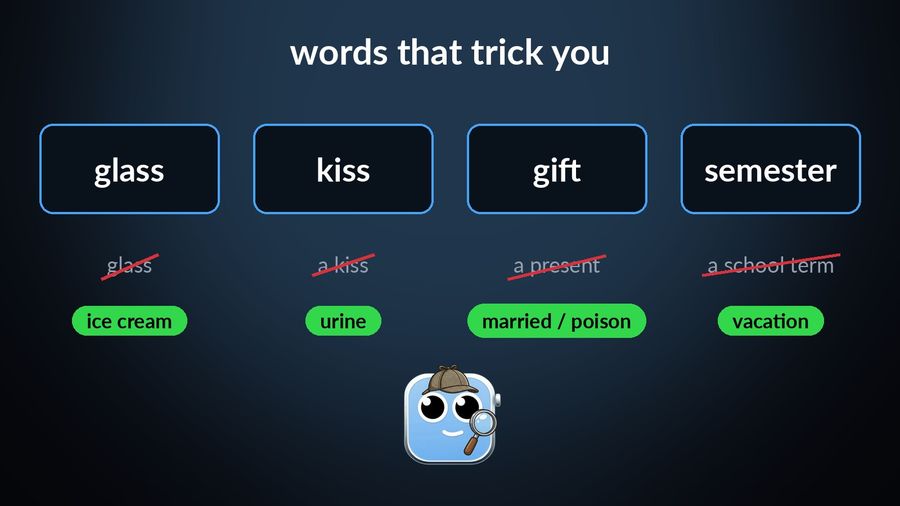
The same closeness that makes recognition fast also hides false friends, and Swedish has several genuinely disruptive ones. Glass is not glass, it is ice cream. Rolig once meant calm, but today it means fun or funny. Fart is speed, harmless and everywhere on road signs (fartkamera, a speed camera). Kiss, awkwardly, means urine rather than a kiss, which is en puss or en kyss instead. Gift means both married and poison, depending on context, while an actual gift is en present. And semester means vacation, not a school term, which is termin. None of these announce themselves: each looks close enough to its English lookalike that the wrong meaning slides in unchallenged.
En, ett, and an article that moves to the end
Swedish nouns split into two genders, en-words and ett-words, in roughly the way Dutch splits into de and het. Most nouns take en (en bil, a car; en dag, a day), a smaller set takes ett (ett hus, a house; ett bord, a table), and the split has to be learned with the word rather than guessed from its meaning. Swedish then does something English does not: the definite article is not a separate word in front of the noun, it is a suffix stuck on the end. Bil becomes bilen (the car), hus becomes huset (the house). An English speaker reaches for "the" automatically; Swedish asks you to remember the noun's gender and its ending at the same time.
Two words become one
Swedish builds new words by joining existing ones directly, with no space and usually no hyphen, which can make a sentence look denser than it is. Sjukhus — one of the words this app's Swedish lists teach, for "hospital" — is simply sjuk (sick) plus hus (house). The same pattern runs through everyday vocabulary: a dining table, matbord, is a food-table; a fire engine, brandbil, is a fire-car. Once you know the parts, the whole is rarely a surprise, but reading a long compound as one unbroken word, rather than hunting for spaces that are not coming, takes some getting used to.
What the spelling will not tell you
Two features of spoken Swedish do not show up clearly on the page. The first is the sj-sound, a fricative spelled several different ways (sj, skj, stj, and sk before a front vowel) that varies by dialect and has no close English equivalent — it is usually the sound that takes longest to approximate comfortably. The second is pitch: Swedish carries a word accent in which some pairs of words are spelled identically but distinguished only by which syllable carries a rising or falling tone. Neither is something a word list can teach on its own; both are worth hearing spoken before you trust your own pronunciation of a new word.
Reading Norwegian, half-following Danish
Swedish, Norwegian and Danish are close enough that a fluent speaker of one can generally read the others in writing without having studied them. Spoken Norwegian tends to be the easier of the two for a Swede to follow; spoken Danish, with its softer consonants and swallowed word endings, is harder even for Scandinavians and often needs a moment of adjustment. It is not full mutual fluency — vocabulary, and occasionally a false friend like rolig, still gets in the way — but it means Swedish vocabulary is not a dead end: it opens a reasonable amount of two neighbouring languages as well.
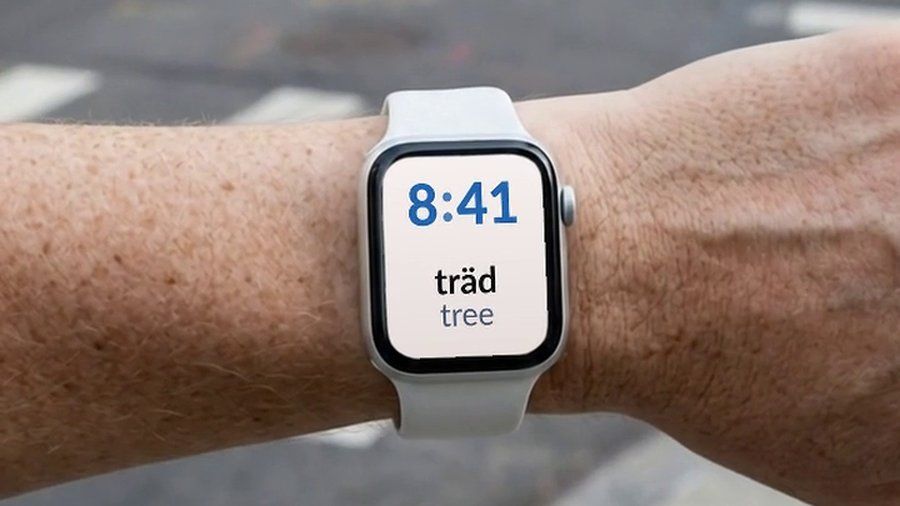

Watch Your Language shows Swedish words on your iPhone Lock Screen and Apple Watch face a few at a time, bringing back the ones you keep forgetting — including a stubborn false friend like glass or gift — until it sticks. With Premium you can add your own words by typing, importing a spreadsheet, or scanning handwritten notes with the camera. It does not teach the sj-sound or Swedish's word accent, so pair it with a resource built for listening and speaking practice.
What this adds up to
Swedish vocabulary gives an English speaker a real head start — plenty of cognates, and a two-way debt to Old Norse that most learners never hear about. The honest caveat is that recognition is not the same as understanding: a handful of everyday words mean something else entirely, gender and the suffixed article have to be learned with each noun, and the sounds worth getting right rarely show up on the page. None of that erases the advantage. It just means the advantage sits in reading and recognising words fast, not in skipping the work of learning them properly.
For a closer look at a similarly close relative, see how Dutch vocabulary tricks English speakers. To see roughly how much vocabulary a working start in Swedish takes, try how long it takes to learn Swedish, or test what you already recognise with the Swedish vocabulary test.