
 Eleanora R.
Most vocabulary lists ask you to learn each word on its own. Arabic does something different: a huge share of its words are built from a small set of three-consonant roots, reshaped by a fixed set of patterns into a verb, a place, a person or a thing. Learn the root ك-ت-ب (k-t-b, the idea of writing) and one pattern at a time, and you are not learning six unrelated words — you are learning one root and five shapes it can take.
One root, one core idea
Arabic grammar calls a root a jadhr. Almost every root is three consonants, stripped of vowels, carrying a core meaning that every word built from it will share in some way. ك-ت-ب carries the idea of writing. Strip the vowels back out of any word in this family and the same three consonants are sitting there underneath:
- كتب — kataba: he wrote (the plain verb)
- كتاب — kitab: book
- مكتب — maktab: office, desk
- مكتبة — maktaba: library, bookshop
- كاتب — katib: writer
- مكتوب — maktub: written — and, as a noun, what is written for you, one's fate
None of that is coincidence or wordplay. A book is the written thing. An office is where writing happens. A writer is the one doing it. Once the root is familiar, a new word built from it arrives already half explained.
Patterns are what turn a root into a word
The root alone is not a word — it needs a template of vowels, and sometimes a prefix, to become one. Arabic grammar calls these templates awzan ( أوزان , "measures"; singular wazn). The same handful of patterns recur across almost every root, which is why they are worth learning as patterns rather than memorising fresh for each new word:
| Pattern | What it marks | From ك-ت-ب | From د-ر-س and ع-ل-م |
|---|---|---|---|
| fa'ala | the plain verb | kataba, "he wrote" | darasa, "he studied" |
| fi'al | the concrete result | kitab, "book" | — |
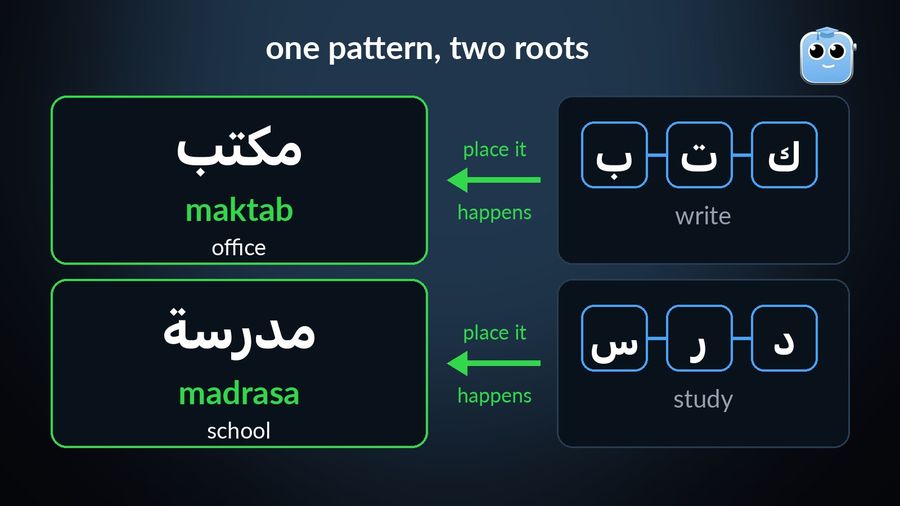
| maf'al / maf'ala | the place it happens | maktab, "office"; maktaba, "library" | madrasa, "school" |
| fa'il | the one who does it | katib, "writer" | 'alim, "scholar" |
| mufa''il | the one who makes others do it | — | mudarris / mu'allim, "teacher" |
| maf'ul | the thing acted upon | maktub, "written" | — |
The second column of examples comes from two more roots: د-ر-س (d-r-s, "study") gives dars, a lesson, and madrasa, a school — the same place-noun pattern that turned writing into an office turns studying into a school. ع-ل-م (ʿ-l-m, "know") gives 'ilm, knowledge, and 'alim, a scholar — the same agent-noun pattern that turned writing into a writer turns knowing into a scholar.
Why this makes vocabulary learnable in families
Once a pattern is familiar, it starts doing real work: meeting an unfamiliar word built on it gives you a head start on what kind of word it is, before you have looked anything up. A noun that opens with ma- and ends in -a is very likely a place — that is what tells a learner who already knows maktaba that madrasa is probably somewhere you go, not something you do. A word shaped like fa'il, with a long vowel after the first consonant, is very likely a person doing the action. Learning six words from one root is not six separate memorisation tasks; the fifth and sixth ones lean on the pattern you already know from the first four.
Where the system stops helping
The pattern does not solve everything. Roots that include a weak letter — و, ي or ء — often shift or drop sounds in ways the tidy k-t-b examples above do not, so the same pattern can look less regular once one of those letters is involved. And a meaningful share of everyday Arabic vocabulary is simply borrowed, with no native root to trace: بنك (bank) came into Arabic from Italian and French banking terms, and فيلم (film) is the English word carried over wholesale. Neither one splits into a three-letter root the way kitab does. Where a language academy has coined a native alternative, both versions often survive side by side — حاسوب (hasub, "computer") was built deliberately from the root ح-س-ب, "to calculate", but plenty of Arabic speakers still reach for the borrowed English word instead. The root system is the backbone of Arabic vocabulary, not a rule without exceptions.
Modern Standard Arabic and the spoken dialects
The words on this page are Modern Standard Arabic: the form taught in courses, used in writing, news broadcasts and formal speech across every Arabic-speaking country, and understood everywhere even though nobody grows up speaking it at home. Everyday conversation runs on regional dialects instead — Egyptian, Levantine, Gulf, Maghrebi and others — which differ from Standard Arabic, and from each other, in pronunciation and everyday vocabulary. The root-and-pattern system keeps working underneath both: a dialect speaker still recognises ك-ت-ب inside their own word for "writer", even where the vowels or the exact word choice has drifted from the Standard Arabic form. A Standard Arabic vocabulary is not wasted once you meet a dialect. It is the shared layer the dialect sits on top of.
A script built to be read fast, not sounded out
Arabic is written right to left in a cursive script whose letters change shape depending on where they fall in a word. Short vowels — the sounds that separate kataba from kutiba, or kitab from a different reading of the same three consonants — are marked by small signs above or below the letters, but adult readers rarely see them: newspapers, novels and everyday signage leave them out, and a fluent reader supplies them from the consonant skeleton and context instead. They stay written in children's books, texts for learners, and religious texts, where precision matters more than speed. Greek is the reverse case: its alphabet writes every vowel, and its difficulty is spelling several sounds more than one way. Arabic asks the reader to supply the vowels, and the root system is exactly what makes that possible: recognising ك-ت-ب inside a run of unvowelled letters narrows down the reading long before the missing short vowels would.
None of this shortens the time it takes to build a working Arabic vocabulary — a realistic estimate is worth checking before you start — but it changes what studying actually looks like day to day. Instead of a flat list, useful practice starts noticing roots on purpose: when a new word turns up, ask what three consonants sit underneath it, and what else you already know that shares them. A short vocabulary check is a quick way to see which roots and patterns have actually stuck and which ones are still six unconnected words in your head rather than one root wearing six shapes.
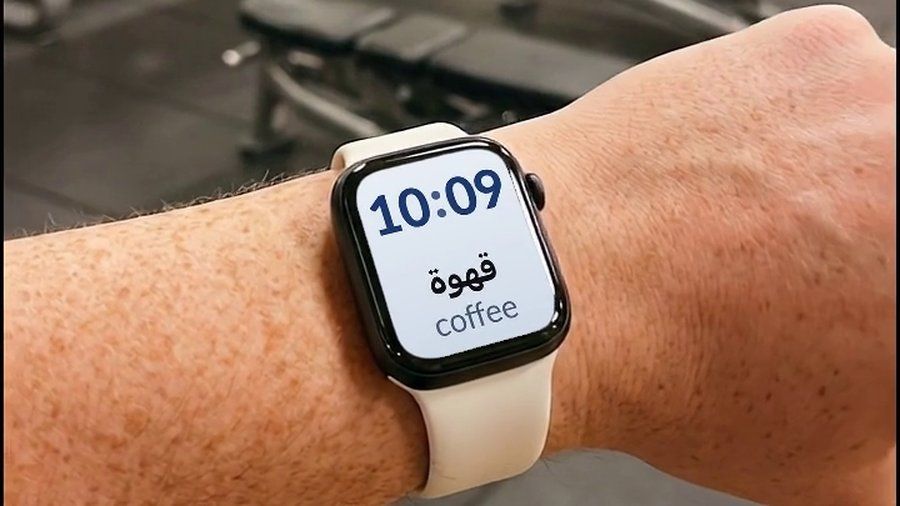

Watch Your Language shows Arabic words in script with a plain transliteration underneath, on your iPhone Lock Screen, Home Screen and Apple Watch face, a few at a time, brought back more often when a word has not stuck yet. It is a passive vocabulary tool rather than a course, so it will not walk you through roots and patterns — but every word it brings back is a chance to ask which three consonants sit underneath it.