 Paul L.
German splits its nouns into three genders. Dutch only has two: de-words and het-words. That sounds like a simplification, and in one narrow sense it is, but the split does not track anything in a noun's meaning, and for most words nothing in its spelling gives it away either. Fewer buckets does not mean an easier guess — it mostly means the wrong guess is less obvious when you make it.
Key takeaways
- Dutch has two genders, de and het, and the split follows nothing in a noun's meaning, so most nouns must be memorised one at a time.
- Two shortcuts hold up: a plural is always de, and a diminutive is always het.
- Learn the article as part of the word (de tafel, not tafel) and say it out loud when you first meet a noun.
Two genders, one of them a merger
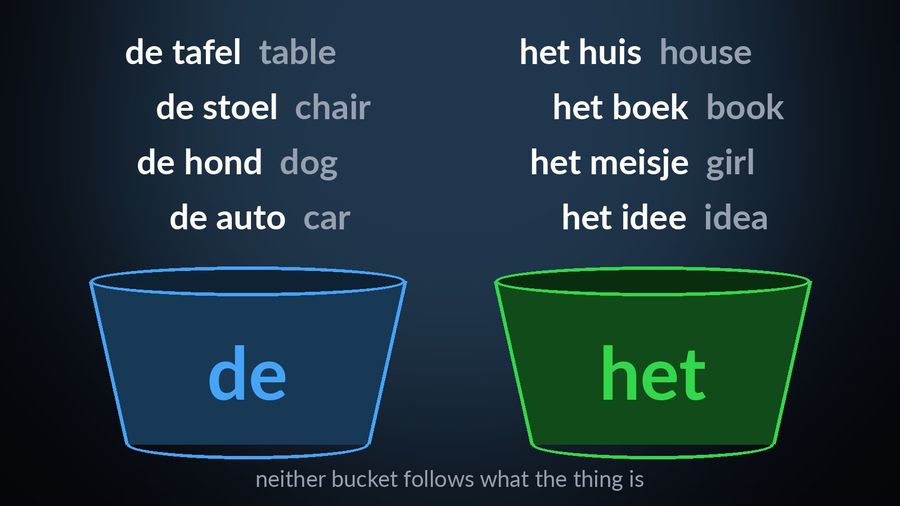
Dutch used to run on three genders as well. Over time the old masculine and feminine categories merged into a single "common" gender, marked by de, while neuter nouns kept their own marker, het. Most everyday nouns you meet now are common gender: de tafel (table), de stoel (chair), de hond (dog), de auto (car). A smaller set is neuter: het huis (house), het boek (book), het meisje (girl), het idee (idea). None of this follows from what the things are — a house is not more "thing-like" than a car — so there is no meaning-based shortcut to fall back on.
A few footholds, not a system
A handful of endings are reliable. Nouns ending in -heid, -ing, -tie, -teit or -iteit are always de words: de vrijheid (freedom), de regering (government), de organisatie. That covers a useful slice of abstract vocabulary and nothing else — most concrete, everyday nouns carry no visible clue, and you learn their gender the same way you learn their spelling: by meeting the word enough times.
Plurals are a more general foothold. Whatever gender a noun takes in the singular, its plural is always de: de huizen (from het huis), de boeken (from het boek), de tafels (from de tafel, unchanged). The moment you are talking about more than one of something, the distinction you were worrying about a sentence ago has already stopped mattering.
The diminutive undoes it again, the other way
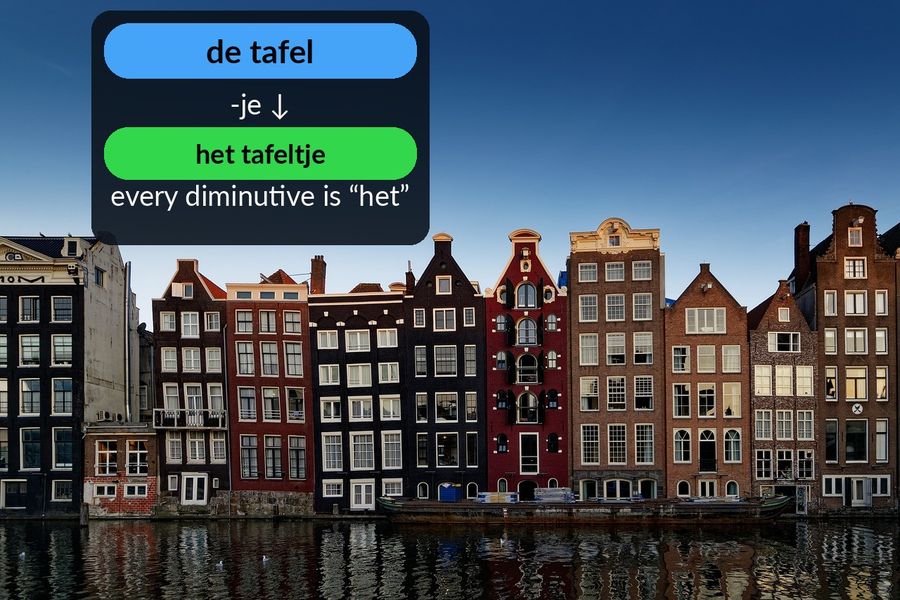
Dutch forms diminutives constantly, by adding -je or one of its spelling variants (-tje, -pje, -etje, depending on how the noun ends) to almost any noun. Every diminutive, regardless of the original noun's gender, is het: de tafel becomes het tafeltje, a common-gender word flipping to neuter the moment you shrink it. And diminutives are not reserved for things that are literally small — a kopje koffie is an ordinary cup of coffee, a broodje is just a sandwich. The suffix softens and casualises as often as it indicates size, which means it shows up far more often than a learner expects, and every time it does, the gender question is already settled.
Where gender actually still shows up
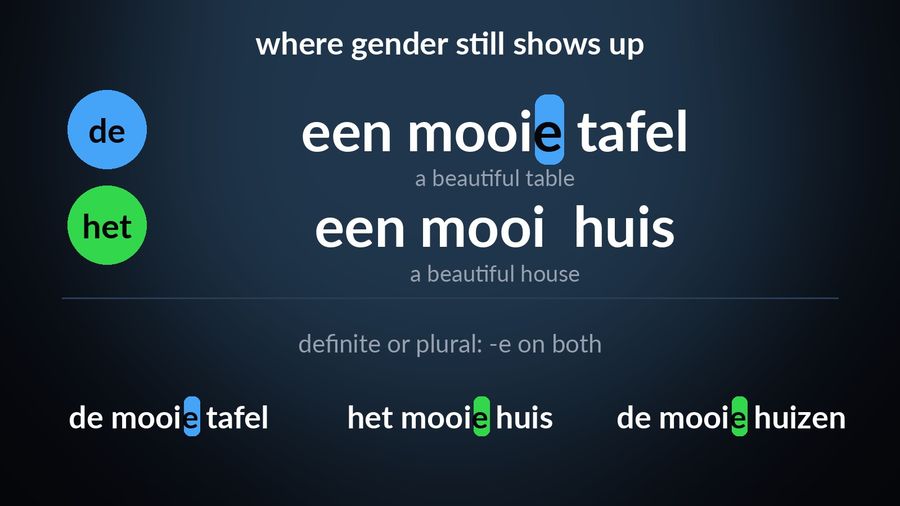
Here is the part that makes the whole system worth learning properly rather than shrugging off: gender decides one adjective ending. Put an adjective in front of an indefinite singular noun and a de-word takes -e, a het-word stays bare — een mooie tafel (a beautiful table) against een mooi huis (a beautiful house). Make either noun definite or plural and the distinction disappears again: de mooie tafel, het mooie huis, de mooie huizen, all with -e. In German, gender and case together reshape articles, adjectives and sometimes the noun itself across most of a sentence. In Dutch, once you strip away the article, gender comes down to whether one adjective, in one specific slot, gets a final -e or not.
What this means for a word list
This app, like most vocabulary tools, stores Dutch nouns in their base dictionary form, without de or het attached. That is a genuine gap: the article is the one detail that tells you which of the few remaining trouble spots — that adjective ending, or picking die over dat when you replace the noun with a pronoun — you are dealing with.


Watch Your Language puts Dutch nouns, with their de or het, on your iPhone Lock Screen and Apple Watch face a few at a time, brought back more often when you have not seen them in a while. Pair that with a habit of saying the article out loud the first time you meet a new noun — attaching it early is far less work than correcting it later.
A practical way to learn it
Treat the article as part of the word, not a separate fact bolted on afterwards — learn de tafel, not tafel. Lean on the two shortcuts that actually hold up: plural is always de, and a diminutive is always het. Beyond that, accept that most nouns simply have to be memorised one at a time, and do not spend much worry on the adjective ending — it only surfaces in one narrow slot, and getting it wrong there is a minor slip, not a sentence a Dutch speaker has to stop and untangle.