 Eleanora R.
If a language keeps sliding off this week's list, the usual diagnosis — "I don't have time" — is rarely accurate. Most people who say this still have commutes, queues, waiting rooms and a phone they check constantly through the day. What they do not have is a free half hour at a fixed time, and most language advice quietly assumes exactly that. The fix is not to find more time. It is to split the job: keep one small sit-down slot for the parts of learning that genuinely need it, and move everything else into the seconds already sitting inside a normal day. Neither half of that split needs to be big. It needs to survive the weeks when nothing else does.
Key takeaways
- Busy people usually lack a fixed hour, not time: split the job into one small sit-down slot for speaking and grammar, and put vocabulary into daily gaps.
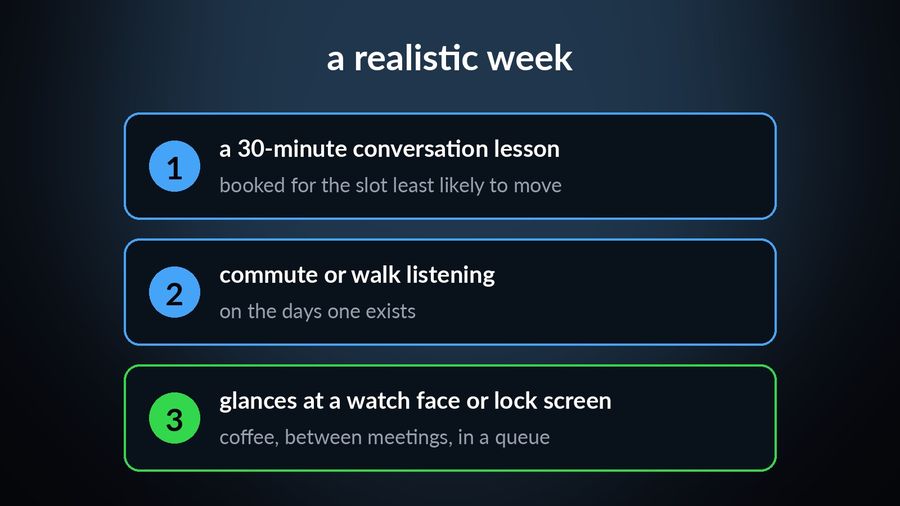
- A realistic week: one 30-minute lesson, listening on a commute or walk, and glances at a watch face or Lock Screen.
- A cancelled lesson is only a one-lesson setback; the habit to protect is the glances, because meeting a word again before it fades is what keeps it.
Why "no time" usually means "no fixed hour"
Most course structures assume a recurring appointment: a lesson at seven, a class every Tuesday, twenty minutes after dinner. For a parent whose evening depends on somebody else's bedtime, or a professional whose calendar is decided by other people, that appointment is the first thing to fall. It only takes one missed Tuesday to feel behind, and feeling behind is usually when people quit altogether.
The more honest fix is to stop building the whole plan around an appointment. Some parts of learning genuinely need a scheduled block of attention. Most of the rest do not, and forcing them into one just adds another reason to fail. Vocabulary in particular survives without a study session — it is the part of the job best suited to being picked up in whatever gaps a busy week already has.
Two different jobs, two different slots
What needs a sit-down slot
Speaking practice and grammar both need your full attention for a stretch of time. Producing a sentence out loud, being corrected, working through how a tense actually behaves — none of that happens in a five-second glance. Watch Your Language is a passive-vocabulary tool: it does not teach grammar or run speaking lessons, and it should not pretend otherwise. For those, a structured course or a conversation partner is the honest recommendation, used for whatever block of time you can protect — even if that is one slot a week rather than five. The point of protecting it is not the number of minutes; it is that this is the only part of the job where skipping it truly means nothing happened.
What fits in seconds
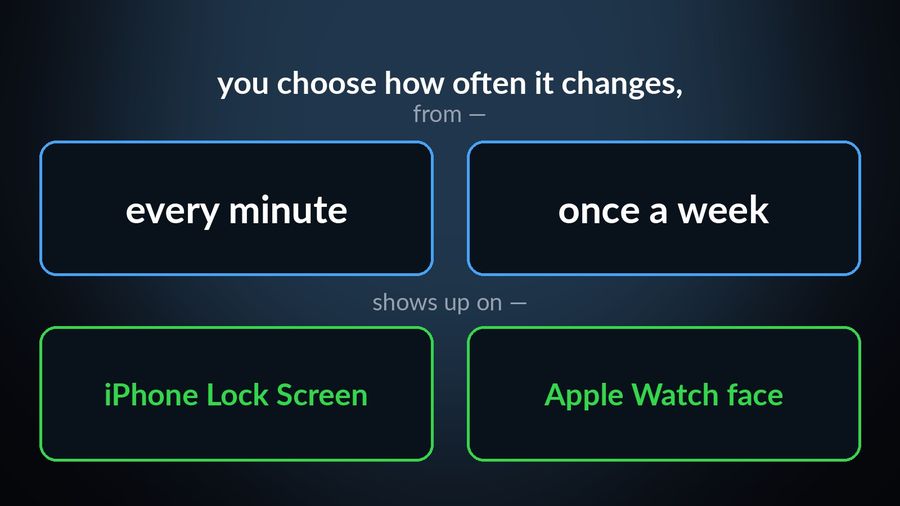
Recognising a word, on the other hand, does not need a desk. It needs repeated, brief contact, which is exactly what a phone or a wrist can deliver without you setting anything aside. The app puts a handful of words from its 25+ languages on your iPhone Lock Screen and Home Screen and in Apple Watch complications on the watch face, and it decides which word to show next from the ones you are close to forgetting. You choose how often it changes, from once a minute up to once a week, so it fits around whatever the day looks like rather than the other way round. Because the same words also show up on the iPhone and iPad, the wrist is not a requirement — someone without an Apple Watch still gets the widgets, just on one fewer surface.
A realistic week
There is no correct number of minutes here; what matters is that the sit-down slot is small enough to survive contact with a real week. One version, offered as an example rather than a rule to copy:
- One 30-minute conversation lesson or class, booked for whichever slot in the week is least likely to move.
- Listening during a commute or a walk, on the days one exists.
- A handful of glances at a watch face or lock screen through the day — waiting for coffee, between meetings, in a queue.
None of that adds up to hours. It adds up to one protected slot and a long list of moments that were already happening anyway, now with a word attached to them. Swap the lesson for a weekly language exchange, the commute for a school run, the watch glances for lock-screen ones on an iPhone or iPad if there is no Apple Watch in the picture — the shape matters more than the specifics. A free calculator can turn a weekly total like this into a rough timeline for a given language and level, once you have a sense of what your week can hold; the estimates behind it are worth reading before leaning on either number too literally.
Getting through a bad week
The sit-down slot is the one that gets cancelled first, and that is fine as long as it is not treated as a failure. A cancelled lesson does not undo the words already learned, and it does not need to be made up. The glances keep happening regardless, because they were never on a calendar to begin with — what keeps a word from fading is meeting it again before it is gone, not the discipline of a fixed hour, so a quiet week is a setback measured in one lesson, not in the whole habit. The only real risk is deciding, after a bad week, that the whole approach failed and stopping the glances along with the lesson — that is the one habit worth defending, because it costs nothing to keep.


Watch Your Language is built for exactly this shape of week: it puts vocabulary on your iPhone and Apple Watch without asking for a session, and schedules the words you are forgetting to come back more often. It will not teach you to speak or explain a grammar rule — pair it with whatever sit-down slot you can protect, and let it carry the vocabulary in between.