 Eleanora R.
The short version: new words fade fast because a single exposure leaves a weak trace, and the trace only gets stronger if you meet the word again near the point you were about to lose it. Some words resist this and stick after one meeting anyway, because of what they mean to you rather than how often you saw them. The fix is not to study harder. It is to review on a schedule, test yourself instead of re-reading, and give new words a reason to matter before you ask them to stay.
Why words fade
A new word does not sit in memory like a file saved to a disk. It is more like a path worn through grass: one crossing barely marks it, and if nothing crosses again soon, the grass grows back. Hermann Ebbinghaus studied this shape of forgetting in the 1880s by memorising lists of nonsense syllables and testing himself on them over days and weeks. The pattern he found, now called the forgetting curve, has held up in study after study since: loss is steepest right after learning, and it slows the longer a memory survives.
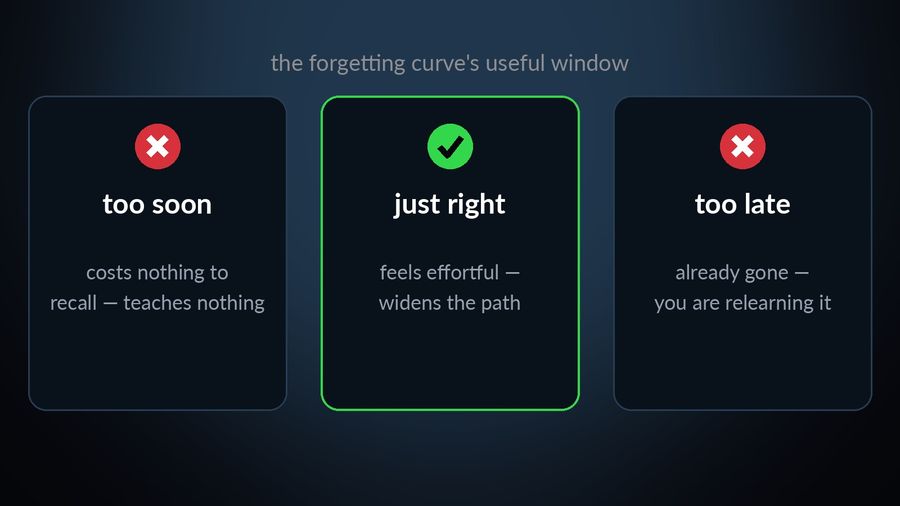
That shape has a practical consequence. A word reviewed too soon costs you almost nothing to recall, which means it teaches you almost nothing — the path was never close to grown over. A word reviewed too late has already gone, and you are relearning it rather than reinforcing it. The useful window sits in between: a review timed just as the word starts to feel effortful is what actually widens the path. Stretching that timing out, a little further after each successful recall, is the whole idea behind spaced repetition, which we explain in more detail in Spaced Repetition, Explained Without the Jargon.
Timing is only one half of it. The other is what you do at the moment of review. Reading a word and its translation again is comfortable, but comfort is a poor sign of learning — recognising something you are looking at requires far less of memory than producing it from nothing. Closing the list and trying to recall the word yourself, then checking, is a different and harder task, and the difficulty is exactly what strengthens the trace. This is known in memory research as retrieval practice or the testing effect, and it has one of the more consistent records in the field; retrievalpractice.org gathers that research for teachers and learners who want to apply it rather than read the papers. The practical version is simple: test yourself before you are shown the answer, every time, rather than reading over a list until it looks familiar.
Why some words stick without any effort
Not every word needs three careful reviews to survive. Some settle in after a single meeting, and the difference is rarely the word's length or difficulty. It is usually one of these.
- Meaning you already have a place for. A word that maps onto a concept you already understand well attaches to something, rather than floating on its own. Abstract words with no obvious anchor take longer, which is why they are worth extra review rather than extra exposure.
- Context that did some of the work for you. A word met inside a sentence, a menu or a conversation arrives with clues about how it is used attached to it. A word met alone on a list arrives with nothing but its translation, so it has to be memorised on its own terms.
- Emotion, even mild. A word tied to a moment that mattered to you a little — an awkward exchange, a joke you understood, a menu item that turned out to be a mistake — is easier to bring back than a word with no story attached, simply because you have more than one route back to it.
- Use. A word you have said or written, even once, is a word your memory has already retrieved successfully. That single act of production does part of the job a formal review session would otherwise have to do.
- Sound. A word that is easy to say, or that echoes something in a language you already know, is simply easier to rehearse silently between reviews, and that rehearsal is a small, free review of its own.
None of this means the ordinary words are a lost cause. It means they need the scheduled review that the memorable ones can partly skip. We go into where this leaves passive exposure — useful, but not a complete answer on its own — in Does Passive Learning Work? An Honest Answer.
What actually helps
Put together, the forgetting curve and the stickiness factors above point to a short list of habits, none of which requires a long session.
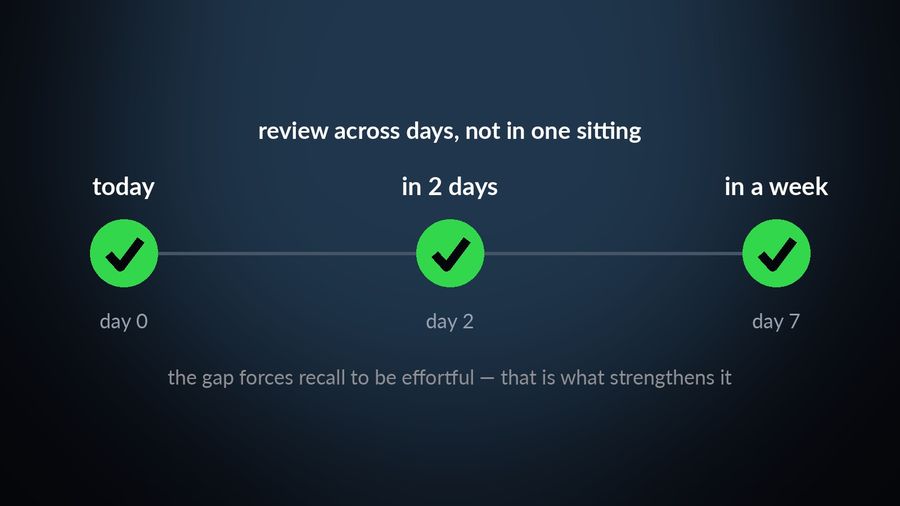
- Review across days, not within one sitting. Ten minutes today, then again in two days, then again in a week, does more than an hour once. The gap is what forces recall to be effortful, and effort is what strengthens the memory.
- Test yourself before you look. Cover the translation, say what you think the word means, then check. If you are only ever reading a list top to bottom, you are mostly rehearsing recognition, not recall.
- Take words from your own life first. A word from something you read, watched or were told beats one from a generic list, for the reasons above: it already has meaning, context and sometimes a story attached. A frequency list is a reasonable place to start if you have nothing yet — our vocabulary level test is a quick way to see roughly where you stand before you build one.
- Say new words aloud. Producing a word, even to an empty room, is a small act of retrieval and gives you a second sense — sound — to hang the word on.
- Use each word once in a sentence of your own. Not a textbook example — a sentence about your actual day. This is a second act of production, and it forces you to notice how the word behaves next to other words, which a translation alone never shows.
- Prefer small and daily to long and occasional. A few words reviewed most days beats a long list crammed once a week, because the forgetting curve resets for anything left too long between reviews. Frequent, brief contact keeps more words inside the window where review actually works. We cover ways to build that daily contact without a dedicated study session in How to Learn Vocabulary Without Study Sessions.
What to expect
None of this makes forgetting stop. The forgetting curve does not go away; the point is to keep meeting each word again before it drops off the edge of it, and to make the meetings count for more by testing yourself rather than re-reading. Words you handle this way settle in over weeks, not overnight, and the words that already had meaning, context, emotion, use or sound attached will keep arriving faster than the rest. That unevenness is normal. It is also, in a small way, useful: it tells you which words still need the scheduled review, and which ones you can quietly let go.


Watch Your Language is built around the scheduling part of this. It shows the words you are learning in widgets on your iPhone Lock Screen and Home Screen and in complications on your Apple Watch face, and decides which word to show next based on which ones you are actually forgetting. You can add words from your own life — typed in, imported from a spreadsheet, or scanned from handwritten notes with the camera — so the words in rotation are ones with meaning and context attached from the start, not a generic list.