 Paul L.

Studying two languages at once raises one real question before any other: will they blur together, so that a word or a grammar habit from one leaks into the other. The honest answer is that this does happen, it is well studied, and it happens far more in some situations than in others. The rest is a matter of which two languages, in what order, and how deliberately you keep them apart.
Key takeaways
- Interference depends on the pair: unrelated languages, or one new plus one you know well, cause the least; related languages started together cause the most.
- Similar languages are cheaper to switch between yet prone to word-level mix-ups, so cognate overlap helps recognition and hurts accuracy.
- Separate them by time of day, context and goal; give the new language your freshest hours and keep the other on light upkeep.
Quick answer
Two unrelated languages, or one language you already know well alongside one brand-new one, cause the least interference. Two closely related languages started at the same time — Spanish and Italian, say, or Dutch and German — are the hardest combination, because the same similarity that makes each one easier to learn is also what makes them easy to confuse. Give the two languages separate times, separate materials and separate goals, and both problems shrink.
When it works, and when it does not
Similar languages versus distant ones
Two languages from different families share little vocabulary and few grammar patterns, so there is not much for one to borrow from the other by mistake. A distant pairing such as Korean and Spanish rarely produces the kind of word-for-word confusion that close pairs do. What a distant pairing costs you instead is raw distance: some languages simply take longer to reach a working level than others, a gap the app's own time-to-learn calculator puts a rough number on once you tell it which languages you already know, and how hard a language is for an English speaker is not the same question as how much it will interfere with something else you are learning.
Closely related languages are the opposite trade. Spanish and Italian, or Norwegian and Danish, share enough cognates and sentence structure that recognising new words comes almost for free — and that same overlap is exactly what produces "Spanitalian" sentences, false friends, and a moment mid-conversation where you genuinely cannot remember which language a word belonged to. Shared vocabulary across related languages cuts both ways: it speeds up recognition and it is also where the mix-ups concentrate.
One new language plus one you are maintaining
The combination that tends to work best in practice is not two languages at the same stage, but one language you are actively building and one you already reached a comfortable level in and now only need to keep from fading. The maintained language needs recognition and light retrieval, not new grammar to absorb, so it can run on brief, spaced contact — a glance at a widget, a word on a watch face — without competing for the sustained attention the new language needs. Two languages at the same early stage compete for that attention in a way that one active and one maintained language do not.
Why interference happens
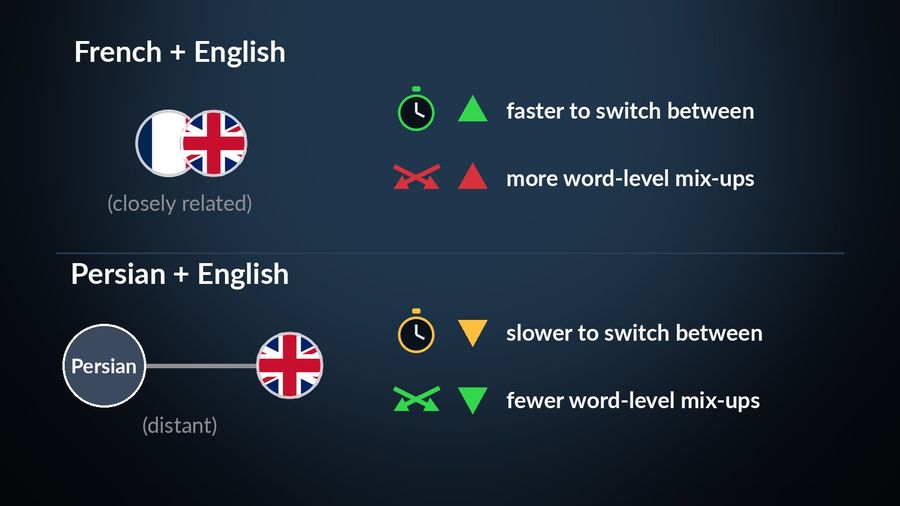
Bilingual speakers keep both languages partly active at once rather than switching one off while using the other, which is why a word in the "wrong" language can surface unbidden. How much that costs depends on how close the two languages are. A 2021 study in Scientific Reports compared bilinguals in a closely related pair, French and English, with bilinguals in a more distant pair, Persian and English, on a language-switching task, and found that the closely related pair showed a lower cognitive cost than the distant pair, with faster reaction times when switching between languages.
Word-level accuracy tells a different story. A study of cognates — words that look and sound alike across two languages — by Laura Muscalu and Patricia Smiley in Bilingualism: Language and Cognition had bilinguals translate words and type the answers. Cognates were started faster, but took longer to type and produced more cross-language spelling errors — facilitation followed by interference, from the same overlap. Similar languages are cheaper to switch between and more prone to word-level mix-ups at the same time; those are two different costs, not one.
There is also a direction to the leakage. The Linguistic Proximity Model, described in a 2017 paper in the International Journal of Bilingualism by Westergaard, Mitrofanova, Mykhaylyk and Rodina, proposes that when someone is learning a third language, influence from the languages they already know works property by property, driven by structural similarity on each specific feature, and can come from either earlier language rather than only the overall closer one. That influence is not always helpful: in their study of Norwegian-Russian bilingual children learning English, it sometimes pushed learners toward the wrong pattern.
How to keep them apart
The practical fix is not willpower, it is separation you do not have to think about. Give each language its own time of day rather than switching between them within a single session — even a fixed order, language A in the morning and language B in the evening, is enough for your brain to treat them as different modes rather than one mixed pool. Give each one its own context too: a different room, a different notebook, a different app view, anything that becomes a reliable cue for "this is language A now." And give each one a different goal, so you are not doing the same drill in both at once — active vocabulary and grammar for the one you are building, light recognition and upkeep for the one you are maintaining.
Practical steps
- Study the newer language when you are freshest, and treat the maintained one as passive upkeep rather than a second study session.
- Keep separate notes, or at least separate sections, so you are never scanning both vocabularies on the same page.
- If the two languages are closely related, hold off starting the second one until the first is solidly past the beginner stage — the confusion is worst when both are equally shaky.
- Say a word out loud in its own language before writing it down; naming which language you are in reduces the accidental blending that happens in silent, fast recall.
- When you do mix two words up, note which two they were — most people find the same handful of pairs trip them up repeatedly, which makes them easy to target once you know what they are.


Watch Your Language studies one language at a time — you can switch to another language at any time, and each language keeps its own progress, so switching back picks up where you left off rather than starting over. That makes it a fit for the maintained side of this pairing: let the language you already know keep surfacing a few words at a time on your iPhone Lock Screen, Home Screen or Apple Watch face, scheduled around the words you tend to forget, while your dedicated study time goes to the language you are actively building.