 Eleanora R.
Quick answer: yes, and the gap is normal. You can recognize a word instantly while reading or listening — call that passive, or receptive, vocabulary — long before you can produce it yourself, unprompted, while speaking or writing, which is active, or productive, vocabulary. The studies that have measured the two separately consistently find the same pattern: passive vocabulary runs ahead of active vocabulary, often by a wide margin, and closing the gap takes a different kind of practice than the one that built it.
Key takeaways
- Recognising a word (receptive) runs well ahead of producing it (productive), and studies keep finding this gap in learners.
- Practice type matters: receptive tasks build recognition, while speaking and writing build production, so closing the gap needs retrieval practice.
- Try recalling before you check, use new words in your own sentences, speak with another person and keep reviewing so words are not forgotten.
What "passive" and "active" vocabulary actually mean
Researchers writing about this usually say receptive and productive rather than passive and active, but the terms describe the same split. Receptive vocabulary is a word you recognize when it is put in front of you — spoken or written — and can retrieve a meaning for. Productive vocabulary is a word you can retrieve and use correctly on your own, with nothing supplying the word for you first. Seeing biblioteca on a sign and knowing it means "library" is receptive. Reaching for biblioteca yourself, mid-sentence, while asking a stranger for directions, is productive.
The two are not simply "further along" versions of the same skill. Recognition is triggered by something arriving from outside — the word is already there, and the task is to match it to a meaning. Production starts from the other end: you have a meaning you want to express, and you have to retrieve the right word, its grammar and its pronunciation, with nothing to prompt you.
Why the gap exists, and roughly how large it is
The finding is old and consistent. A review of the vocabulary-testing literature by Tran-Hoang-Thu (2009) traces it back to a 1930 study by Morgan and Oberdeck and reports that the five recent studies it covers — Fan (2000), Laufer (1998), Laufer and Paribakht (1998), Waring (1997) and Webb (2008) — share one notable result: receptive vocabulary knowledge is generally larger than productive vocabulary knowledge, for learners of English both as a foreign language and as a second language. Laufer and Paribakht, who compared learners in both settings, went further: as the review summarises them, passive vocabulary is likely to take a long time to become active, or may never become active at all.
How large the gap is varies by study and by learner. Testing Japanese university undergraduates, Waring (1997) found a receptive vocabulary of roughly 2,236 word families against a productive vocabulary of about 1,537 — a drop of nearly a third — a result reported in a later study by Hajiyeva (2015), who also cites Waring's estimate that productive vocabulary runs at roughly half of receptive vocabulary and Milton's (2009) wider estimate of 50 to 80 percent. In Hajiyeva's own year-long study of 159 first-year English majors in Azerbaijan, the gap narrowed as instruction went on: productive vocabulary grew by 21 percent over the year while receptive vocabulary did not grow at all, closing some of the distance between them — a sign that the ratio is not fixed. For a sense of the vocabulary sizes these ratios apply to, see how many words you need to be fluent.
How a word moves from passive to active
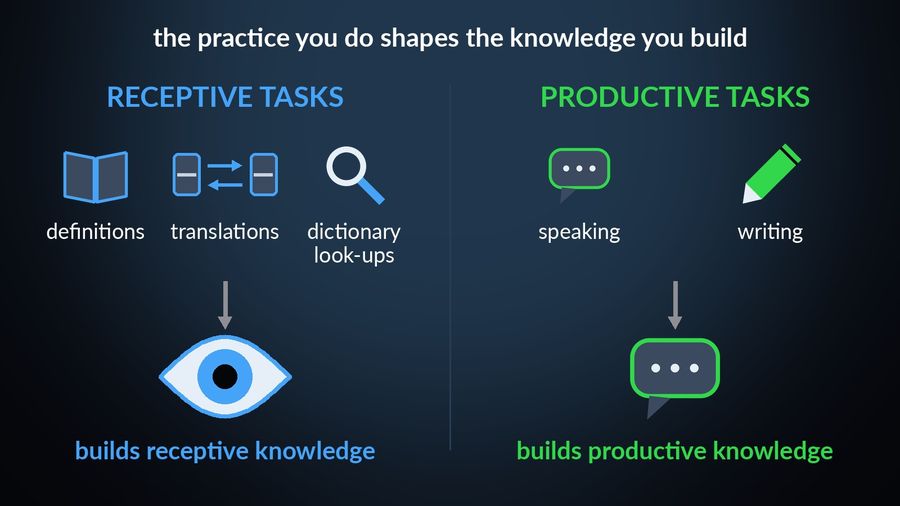
The mechanism researchers point to is straightforward, if inconvenient: the kind of practice you do shapes the kind of knowledge you build. Webb (2009), as summarised by Tran-Hoang-Thu, found that the type of task affects what learners can do with a word: receptive tasks — providing definitions or translations, looking words up in a dictionary — may help increase receptive knowledge, while productive tasks such as speaking and writing help improve productive knowledge. The same review notes Webb's (2005) observation that classroom vocabulary teaching is usually receptive by default: a teacher supplies a meaning or a definition, and learners are rarely asked to produce the word themselves beyond spelling or pronouncing it.
This is not an argument against passive exposure. Recognizing a word reliably is a real prerequisite for using it, and on its own it is most of what you need to read and follow speech — see does passive learning work for what that kind of exposure can and cannot do by itself. But recognition alone does not train retrieval, and retrieval is what speaking and writing demand. The two skills need two different habits.
Practical steps that build active vocabulary
A few habits reliably push a word from passive toward active, based on what the research above points to:
- Retrieve before you check. Try to recall a word's meaning, or the word itself, before you look it up or get it corrected. The act of trying, even when you fail, is part of what strengthens the memory.
- Use it in a sentence of your own, not one copied from a book. A sentence you construct yourself forces you to retrieve grammar and pronunciation alongside the word, which is closer to what speaking demands than simply reading it in context.
- Speak or write regularly with another person, even briefly — a tutor, a language exchange partner, or a conversation group. Productive knowledge, more than recognition, seems to depend on being asked to produce, not just being exposed.
- Keep the review going. A forgotten word cannot become productive at all. Spaced review that resurfaces words you are close to forgetting keeps the raw material available for the harder work of production; see how spaced repetition works for the mechanics.
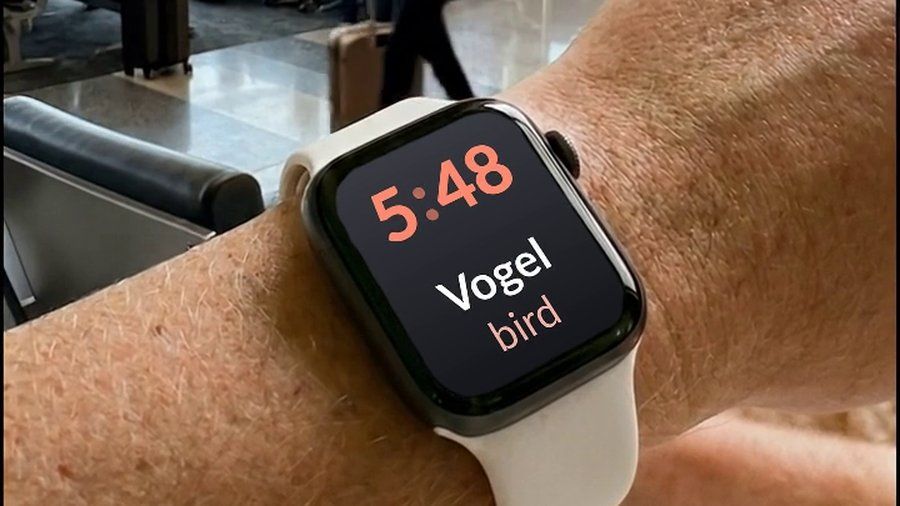

Watch Your Language is built for the first half of this gap, not the second. Vocabulary appears in widgets on your iPhone's Lock Screen and Home Screen and in Apple Watch complications throughout the day, scheduled by spaced repetition so words you keep forgetting come back more often, at an interval you choose. The Watch app adds a self-test closer to retrieval than simply seeing a word go by: it reveals a word and lets you mark whether you got it right, which is recall practice, not production. Turning that recognition into words you can actually speak or write still takes a tutor, a conversation partner, or a writing habit of your own.