 Paul L.
Language learning attracts more folklore than most subjects a person picks up as an adult. Some of it talks people out of starting, or into paying for something that cannot deliver what it promises. Below are seven claims that come up constantly, checked against the research behind each one, with a link to where that research is published rather than a number pulled from memory.
Key takeaways
- Seven claims checked: native-like grammar ability declines gradually after about 17, not at a childhood cutoff, so adults can still reach a useful level.
- Learning styles have no support (Pashler 2008); instead use methods with evidence for everyone, like spaced repetition and retrieval practice.
- An app alone will not make you fluent; use it for steady vocabulary contact and get grammar and speaking practice from a class, tutor or partner.
"Adults can't learn a language as well as children"
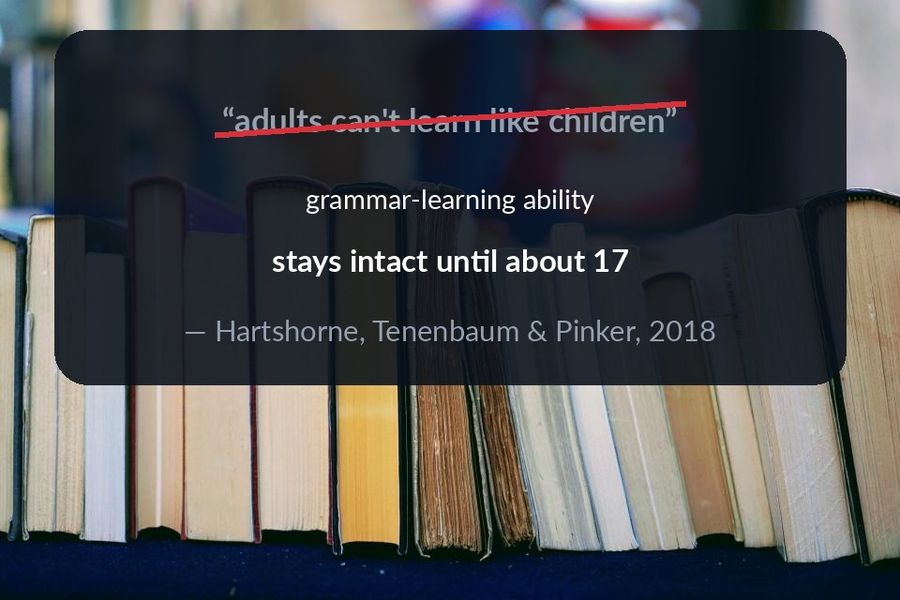
This one has real research behind part of it, and it is usually stretched past what that research says. One of the largest studies of the question, by Joshua Hartshorne, Joshua Tenenbaum and Steven Pinker (published in Cognition in 2018), modelled grammar-learning ability in nearly 670,000 English speakers and found that the capacity to learn grammar to a native-like level stays largely intact until around age 17, then declines steadily — a later and more gradual turning point than a childhood cutoff, and not a wall adults hit.
What that means in practice: an adult is very unlikely to end up grammatically indistinguishable from a native speaker who started as a child. It does not mean an adult learns slowly, or cannot reach a genuinely useful, comfortable level. Adults bring reading skills, study strategies and existing vocabulary in other languages that children do not have, and none of that disappears at 18.
Do instead: treat "started late" as irrelevant to whether it is worth starting at all, and put your energy into regular contact with the language rather than worrying about the ceiling.
"You need to be naturally 'talented' at languages"
Aptitude is real and measurable, and it does predict some of the difference between learners — but a 2024 mini review in Frontiers in Psychology by Chuandai Qiao, which summarises the research on factors that shape second-language learning, reports that aptitude's effect depends on context: it correlates more strongly with explicit, rule-focused instruction than with implicit learning, and it plays its most prominent role in the early stages and in conscious learning conditions. Aptitude is one input among several, not a gate that is open for some people and closed for others.
Do instead: stop treating early difficulty as proof you lack an ability other people have. How far you get depends on more than one variable, and the amount of time you keep going is one you control.
"Match your studying to your 'learning style'"
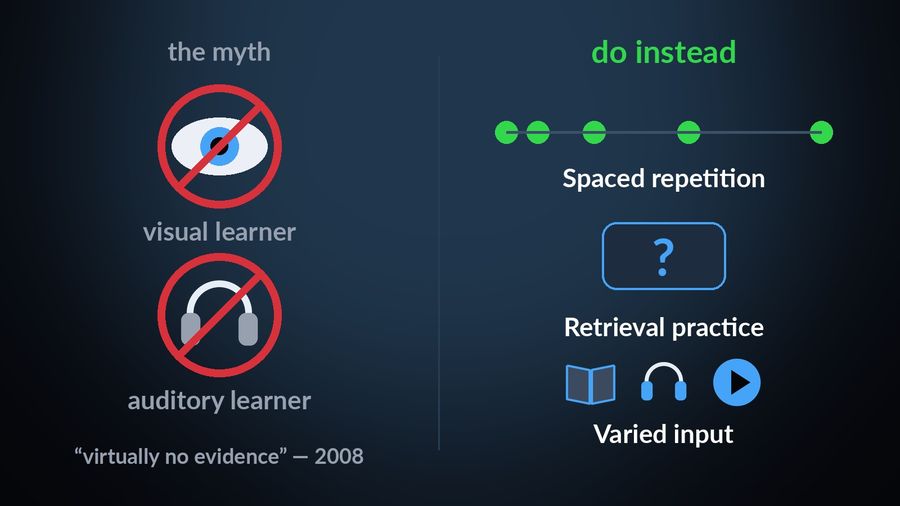
The idea that a "visual learner" retains more from diagrams while an "auditory learner" retains more from listening — and that matching the format to the person improves learning — is one of the best-tested claims in education, and it has failed every rigorous test. Harold Pashler and colleagues reviewed the evidence in 2008 in Psychological Science in the Public Interest and found "virtually no evidence" for the specific pattern the theory predicts — that a person taught in their preferred style outperforms the same person taught in a different one. They stopped short of saying no version of the idea could ever work, only that the popular version has no support.
Do instead: use methods with evidence behind them for everyone — spaced repetition, retrieval practice, varied input — rather than filtering study methods through a self-assessed style that the research has not been able to confirm matters.
"You must immerse yourself abroad to really learn"
Moving somewhere the language is spoken can help, but the research on study-abroad outcomes is less tidy than the idea suggests. A 2018 review of study-abroad research by Christina Isabelli-García, Jennifer Bown, John Plews and Dan Dewey in Language Teaching stresses that "not all experiences are equivalent": outcomes vary between individuals, and success depends not only on the learner but also on how they are received by the host community and how much real contact they get.
Do instead: if travel is not realistic, prioritise the thing that actually drives the gains — regular, engaged use of the language — over the location. A weekly conversation partner and daily contact with the language at home outperforms a trip with little real interaction in it.
"A few minutes a day is enough for fluency"
This depends entirely on what "fluency" is being asked to mean. The U.S. Foreign Service Institute, which trains American diplomats, lists 30 weeks (690 class hours) for French or Spanish, about 36 weeks (828 class hours) for German, and 88 weeks (2,200 class hours) for Mandarin, Japanese, Korean or Arabic, as the time its students usually need to reach professional working proficiency in speaking and listening (level 3 on the ILR scale) — see our breakdown of why some languages take English speakers longer than others. A few minutes a day adds up to a small fraction of that over a year.
None of this means short daily sessions are worthless — spaced, low-effort exposure is a genuinely good way to build recognition vocabulary over months, and our own page on how many words fluency actually takes goes into what that number really looks like. The honest claim is narrower than "fluency": a few minutes a day, kept up for a long time, steadily builds the vocabulary that later study stands on.
Do instead: pick the outcome you actually want — recognising words, holding a basic conversation, reading a novel — and size the time commitment to that goal rather than to a number that was never attached to "fluency" in the first place.
"An app by itself will make you fluent"
A 2022 systematic review by Kee-Man Chuah and Muhammad Kamarul Kabilan in the International Journal of Learning, Teaching and Educational Research examined 39 published studies that developed language-learning apps. It found that researchers mostly built apps to address vocabulary learning and learner motivation, and that very few of them drew on theories of language acquisition when designing them. Those were research prototypes, not commercial apps, but the emphasis is a familiar one.
This app sits squarely on the vocabulary side of that picture, and it does not pretend otherwise: it is a passive vocabulary tool, and passive vocabulary is one part of learning a language, not the whole of it. It does not teach grammar or run speaking or listening lessons — pair it honestly with something that does, and our piece on what passive learning can and cannot do lays out that division in full.
Do instead: use an app for what apps are demonstrably good at — steady, low-friction vocabulary contact — and get your speaking and grammar practice from something built for that job, whether a class, a tutor or a conversation partner.
"Children learn languages effortlessly, adults have to struggle"
An article from Bilingualism Matters at Penn State makes a point worth sitting with: you would have to stay in a typical language class for your entire life to get the same amount of input as ten years of immersion. Children are not faster at the start — the same article notes that adults and older children learn more quickly in the beginning stages, and that in the classroom adults learn grammar just as well as children, and faster. Much of what looks like effortless childhood fluency is years of near-constant exposure.
Do instead: do not measure your progress against a child's outcome after years of all-day exposure you are not getting. Measure it against the amount of contact you are actually putting in.
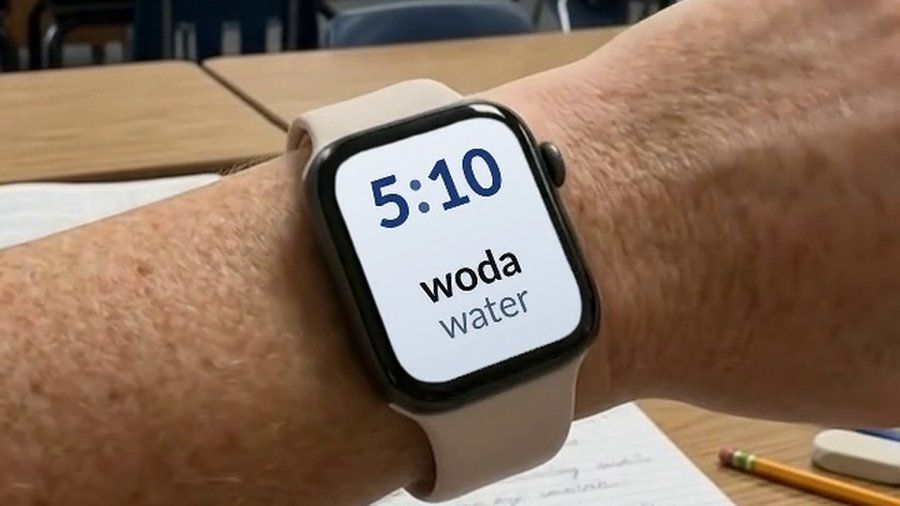

Watch Your Language is built for the one claim above that does hold up: steady, low-effort contact with vocabulary over a long stretch of time. It puts words from 25+ languages on your iPhone Lock Screen, Home Screen and Apple Watch face, and decides which ones to bring back based on which you keep forgetting. It is not a fluency shortcut and does not teach grammar, speaking or listening — pair it with whichever of the methods above you are already using, and let it handle the vocabulary in the background.
Reading claims like these
None of the seven claims above are pure fiction — each one starts from something real. The pattern worth noticing is where the exaggeration creeps in: a gradual decline becomes a hard cutoff, an average becomes a guarantee, and "helps" becomes "is enough on its own." The version of each claim that survives contact with the research is usually the less exciting one, and also the one worth actually planning around.