 Paul L.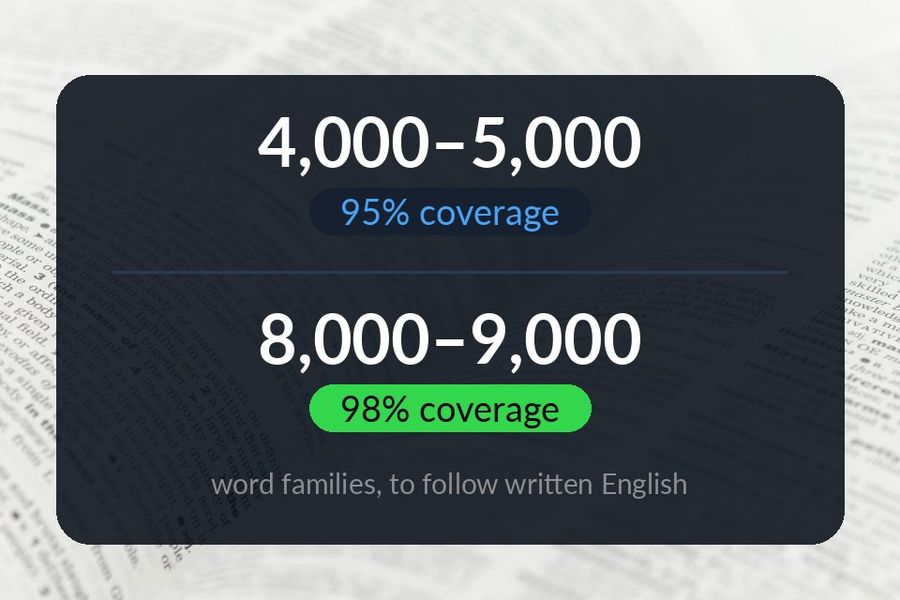
There is no official number, and anyone who gives you one without a caveat is rounding off a genuinely messy question. What research on reading and listening comprehension does give you is something more useful than a target: a handful of concrete word counts tied to what you can actually do at each one, and a much better second question to ask than "how many".
Key takeaways
- No official number exists; research ties vocabulary to text coverage: about 98% coverage needs roughly 8,000-9,000 word families for written English, 6,000-7,000 for spoken.
- Laufer and Ravenhorst-Kalovski found 4,000-5,000 word families gives 95% coverage, enough to get by, and the first words you learn buy the most coverage.
- Name your goal, test your level, aim at the next band rather than the ceiling, and keep old words alive with spaced repetition.
What "fluent" actually means
People use "fluent" to mean everything from "I can order food and find a train platform" to "a stranger would not guess I learned this as an adult". Linguists mostly avoid the word for exactly that reason. The nearest thing to a formal definition is the top of the CEFR scale — C2, described as close to an educated native speaker's command of the language — and even that is a band, not a single line you cross. If you want to know roughly where you already sit on that scale, our free vocabulary level test gives you a CEFR estimate in a few minutes; we cover the six levels one at a time in our guide to CEFR levels.
How many words the research actually points to
The most useful studies do not ask "how many words does a fluent speaker know" directly. They ask a narrower, testable question: what share of the running words in a text or a conversation do you need to recognise before you can follow it without help, and how large a vocabulary gets you there? Linguists call that share "text coverage", and count vocabulary in "word families" — a base word plus its regular inflections and closest derived forms, counted once.
I.S.P. Nation's study of the British National Corpus, one of the most cited pieces of work on this question, found that unassisted comprehension needs around 98% coverage of a text. To reach that for written English, Nation put the requirement at 8,000 to 9,000 word families; for spoken English, a smaller 6,000 to 7,000, because everyday speech draws on a narrower set of words than a novel or a newspaper does (Nation, 2006). The same paper puts a well-educated native speaker's vocabulary at roughly 20,000 word families — the ceiling, not a realistic milestone for a learner.
Batia Laufer and Geke Ravenhorst-Kalovski revisited the same question with a different method — testing learners directly rather than only counting corpus frequencies — and arrived at two useful thresholds instead of one: an "optimal" threshold of 8,000 word families for 98% coverage, close to Nation's figure, and a lower "minimal" threshold of 4,000 to 5,000 word families for 95% coverage, which was enough for passing but not comfortable comprehension (Laufer & Ravenhorst-Kalovski, 2010). In plain terms: a few thousand of the right words get you through a text without constantly reaching for a dictionary; it takes roughly double that to stop noticing you are reading in a second language at all.
Two things are worth holding onto from both studies. First, a "word family" is a wider unit than a single dictionary entry, so a count in word families is never directly comparable to a flat word list — check how any vocabulary size claim was counted before you compare it to another. Second, coverage climbs in the wrong direction to reward effort evenly: the first thousand or two words buy you most of your coverage cheaply, and every thousand after that buys less, because the words left to learn get rarer.
Why the number moves depending on the language
These thresholds were measured on English, and they travel reasonably well to other languages built the same way — one script, one common reading per written word, meaning changes signalled mostly by adding endings. French sits comfortably in that group: our breakdown of how many French words you need uses the same idea, sorting vocabulary by CEFR level so you can see what a given band actually buys you.
Japanese breaks the assumption at the root. A single kanji character can carry several unrelated readings depending on the word it appears in, ordinary nouns are compounds of characters you may only half-know, and counting objects needs a second small vocabulary of counter words layered on top of the numbers. We go through why in why "how many Japanese words" is the wrong question — the short version is that a word count for Japanese answers a different, narrower question than the same count does for French, so the two are not directly comparable even when the number looks similar.
Four practical steps
A target you cannot act on is not much use, so turn the research above into something closer to a plan.
- Name the goal, not the number. "Order food and ask directions" and "read a novel without a dictionary" call for different vocabulary sizes and different words. Decide which one you actually want before picking a target.
- Find out where you already stand. Guessing your own level wastes effort in both directions — repeating words you know, or reaching for ones far above you. Our free vocabulary level test gives you a CEFR estimate to start from.
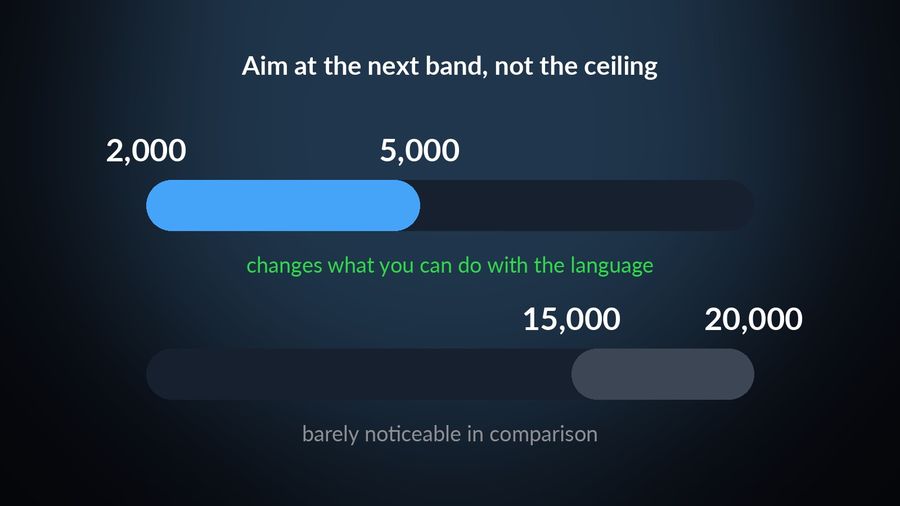
- Aim at the next band, not the ceiling. Going from roughly 2,000 to 5,000 words changes what you can do with a language far more than the jump from 15,000 to 20,000 ever will. Work through the closer band first.
- Keep the old words alive while you add new ones. Vocabulary you do not meet again fades, which is the whole case for spaced repetition — reviewing a word just as you are about to forget it, rather than on a fixed schedule. We explain the method in how spaced repetition works.
The better question
Not "how many words for fluency", but "how many of the right words, reviewed often enough not to lose them". A vocabulary count is a snapshot; what actually determines whether you can follow a conversation next year is whether the words you learned this month are still there when you need them.
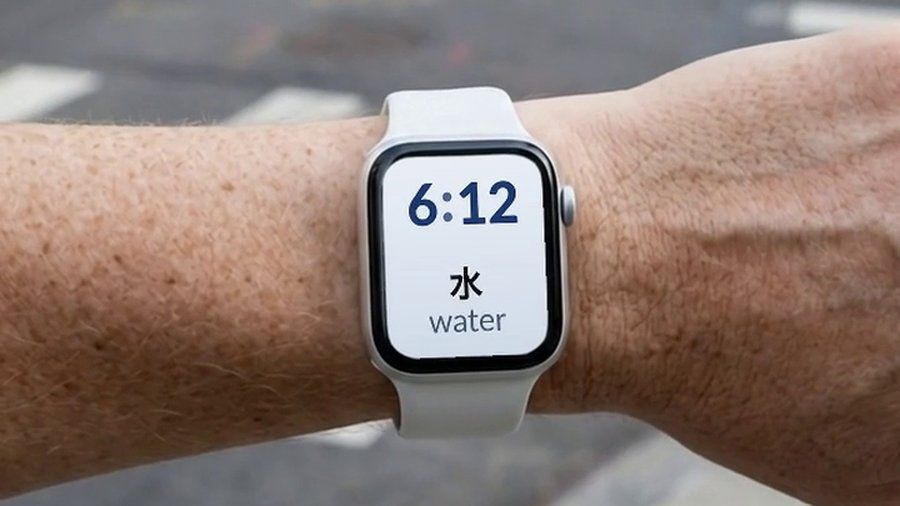

Watch Your Language does not promise a number or a finish line. It shows a handful of its 10,000+ words at a time, graded from A1 to C2, on your iPhone Lock Screen, Home Screen and Apple Watch face, and brings back the ones you are still forgetting more often than the ones you already know. It is a vocabulary tool, not a grammar or speaking course — pair it with one of those for the rest of the job.