 Paul L.
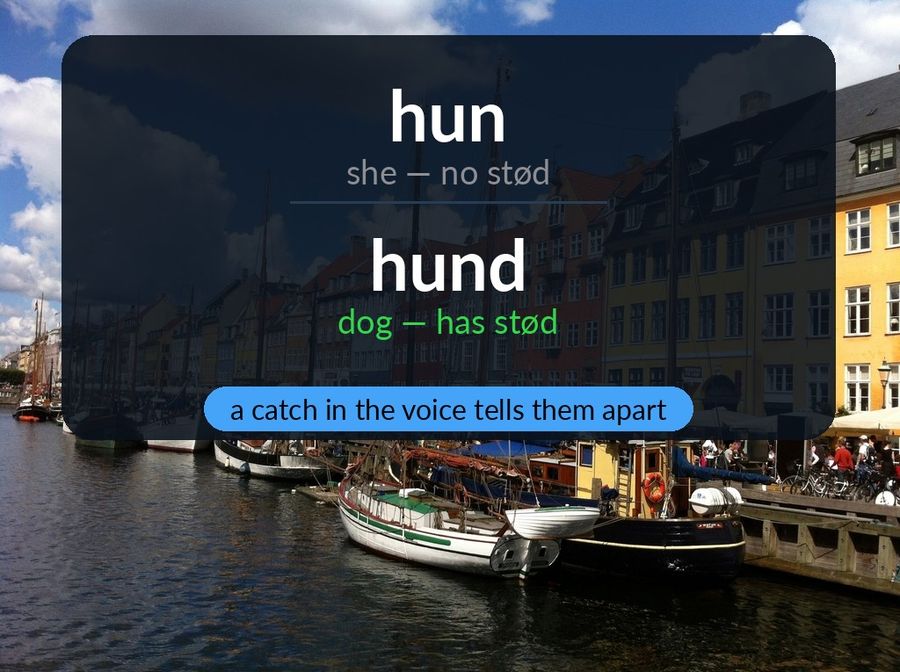
Quick answer: Danish is written in the Latin alphabet with only three extra letters (æ, ø, å) and shares a large stock of Germanic vocabulary with English, so reading it is often easier than reading French or Polish. Spoken Danish is a different matter. A feature called stød, a distinctive "soft d", and consonants that soften or drop out in casual speech mean the sound of a Danish word regularly drifts a long way from how it is spelled.
Key takeaways
- Danish is easy to read (Latin alphabet plus æ, ø, å; shared Germanic words like hus and bog) but its spoken form drifts far from the spelling.
- Three causes: the soft d, stød (a catch in the voice that separates hund from hun), and consonants that fade in casual speech.
- Learn each word's spelling and sound together, listening first; Watch Your Language keeps the written word in view but teaches no pronunciation.
Why Danish text is easy to read
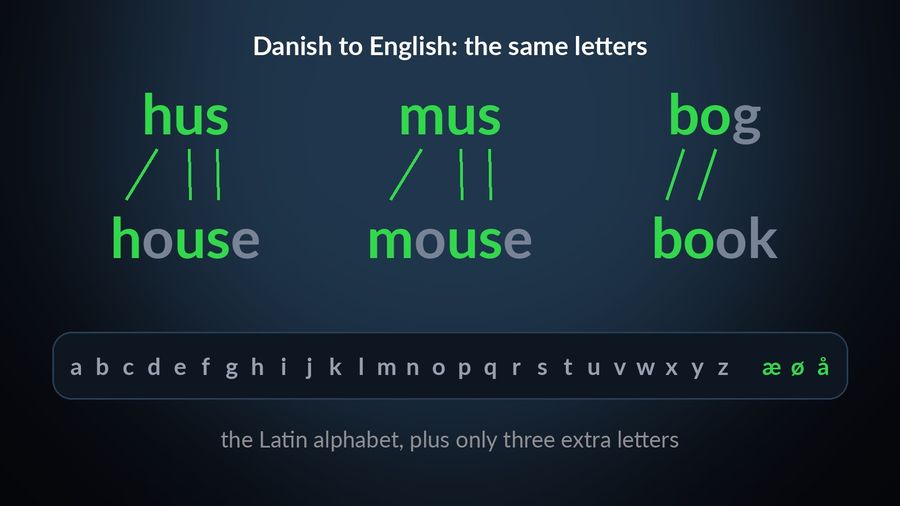
For an English speaker starting from zero, Danish spelling is unusually approachable. It uses the Latin alphabet, with just three extra vowel letters — æ, ø and å — and no other accents to track. Because English and Danish both descend from Germanic roots, plenty of basic words are recognisable on sight: hus (house), mus (mouse), bog (book). Danish also shares much of its everyday vocabulary with its Scandinavian neighbours, which is worth knowing if you are weighing the three against each other — see how Norwegian splits into two written standards, how close Swedish vocabulary is to English, and the wider picture in cognates across 28 languages.
Why it doesn't sound the way it reads
Reading ease is exactly what makes spoken Danish surprising. Three features pull pronunciation away from the spelling, and all three are described in detail on Wikipedia's page on Danish phonology.
The first is what is usually called the "soft d" (blødt d), the sound written as a plain "d" in words like mad (food) or rød (red). It is not the crisp "d" an English speaker expects. Descriptions of Danish phonology note that non-native listeners often perceive it as closer to an "l" than to a "d" (Wikipedia, Danish phonology) — so a word that looks like it ends in a firm consonant often trails off into something softer and less definite.
The second is stød, a short catch or creak in the voice that Danish uses the way some languages use tone — not as decoration, but to tell two words apart. It is described as a kind of creaky voice, or laryngealisation, carried on a vowel or a following sonorant (Wikipedia, Stød). A standard textbook example: hun ("she") has no stød, while hund ("dog") does, so two words spelled almost alike are told apart in speech by that catch rather than by the letters themselves (Wikipedia, Stød). Ordinary Danish spelling does not mark stød at all, so nothing on the page warns you it is there.
The third is consonant reduction. Danish is described as showing markedly more lenition — the weakening of consonant sounds — in casual speech than Norwegian or Swedish (Wikipedia, Danish phonology), so consonants that sit clearly in the spelling can fade or vanish once a word is spoken at normal speed. On top of that, Danish is generally described as having an unusually large vowel inventory for a European language, commonly put at around twenty distinct vowel qualities (Wikipedia, Danish phonology), so two spellings that look like they should rhyme can land on noticeably different vowels.
Eight Danish words: spelling next to a rough sound hint
The hints below are not phonetic transcriptions. They are a rough, plain-English sense of how far the spoken word drifts from the spelling, meant to be read alongside an actual recording rather than instead of one.
| Danish | Meaning | Rough sound hint |
|---|---|---|
| hej | hello | close to the spelling — similar to the English "hi" |
| tak | thank you | close to the spelling, roughly rhyming with "stock" |
| rød | red | not a clear "d" sound at all; the word ends in a soft catch (stød) instead |
| brød | bread | the same soft, catch-ended finish as rød |
| mad | food | the d softens until it is barely there |
| hund | dog | the d fades, and a stød is what actually separates it, in speech, from hun ("she") |
| gade | street | the middle d is soft, not a hard English d — closer to how the "soft d" is generally described |
| hård | hard | ends with a stød catch, and the final d nearly disappears |
What this means for learning Danish vocabulary
None of this makes Danish vocabulary hard to learn — recognising and recalling a word is a different skill from producing its sound, and a vocabulary app only concerns itself with the first one. What it means is that the written word and the spoken word need to be learned together rather than one standing in for the other. Reading rød off a page will not teach you the stød on its own, and hearing rød spoken will not teach you to spell it. Danish is a language where the usual shortcut — read it, and you can probably say it close enough — does not hold nearly as well as it does in most other languages that use the Latin alphabet.
Practical steps
- Learn the written word and its sound side by side, from the start. Do not memorise the spelling first and add the sound later — the gap between them is exactly the part that trips people up.
- Listen before you try to say a new word. A stød or a soft d described in text is a starting point, not a substitute for hearing it.
- Say hej and tak early and often. Some Danish words really do sound close to their spelling, and building confidence on the easy ones makes the harder ones less intimidating.
- Treat hun and hund as your test pair. If you can learn to hear the difference between a word with stød and one without, most of the rest of Danish pronunciation follows the same pattern.
- Expect Danish speech to sound less distinct than Danish text looks. That is the lenition described above, not you mishearing, and it happens to every learner at first.


Watch Your Language shows Danish vocabulary, spelled as you would find it in a dictionary, a few words at a time on your iPhone Lock Screen and Apple Watch face, brought back more often when you keep forgetting one. When you practise on the iPhone, you can also have a word read aloud with text-to-speech. It will not teach you a stød or the soft d itself — it is a passive vocabulary tool, not a pronunciation course — so pair it with real recordings or a Danish speaker for the sound, and let it handle keeping the written word in view until it is familiar.
Danish sits close to Norwegian and Swedish in vocabulary, which is worth knowing if you are choosing between the three: see how Norwegian's two written standards compare, how close Swedish vocabulary is to English, and the wider picture of cognates across 28 languages. To see how many Danish words you already recognise, try the Danish vocabulary test, and for a rough sense of the vocabulary side of the timeline, the how long to learn Danish calculator gives a starting estimate.