 Eleanora R.
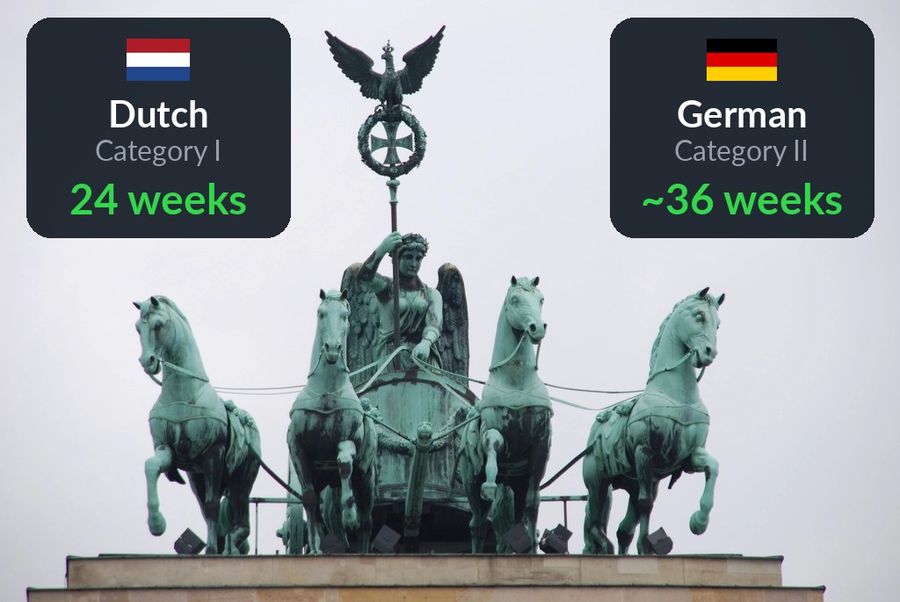
Quick answer: if speed is what matters, Dutch gets you there faster — the United States' Foreign Service Institute places it in its easiest tier for English speakers, alongside French and Spanish. German sits one tier up, mostly because of its case system. If what matters is where you will actually use the language, or how much of the vocabulary you can already half-guess, the answer changes, and the two languages overlap far enough that learning one first is rarely wasted time on the other.
Key takeaways
- Verdict: Dutch is faster for English speakers (FSI Category I, about 552 class hours); German is one tier up (about 828 hours), mostly because of its case system.
- Both put the verb second in main clauses and last in subordinate ones, and share many roots (water, huis/Haus), with false friends like bekommen and slim.
- Choose by where you will use it: German reaches more countries and speakers, Dutch gets you speaking sooner. Learning either first is not wasted.
How close each one is to English
The Foreign Service Institute trains American diplomats and ranks languages by how many weeks of full-time classroom instruction they typically take an English speaker to reach professional working proficiency. Category I, the easiest band, runs 24 to 30 weeks, 552 to 690 class hours, and Dutch sits at the fast end of it: 24 weeks, about 552 class hours. German is a category up, Category II, at roughly 36 weeks and 828 class hours — nearly 300 hours more than Dutch, almost entirely down to grammar rather than vocabulary.
| FSI category | Weeks | Class hours | Language |
|---|---|---|---|
| Category I | 24 | ~552 | Dutch |
| Category I | 24–30 | 552–690 | French, Spanish, and the rest of the tier |
| Category II | ~36 | ~828 | German |
Those figures describe classroom hours toward professional fluency, not casual conversation, and they assume an adult with no head start in either language. Treat the gap as real but not decisive: it tells you German asks more of your grammar, not that Dutch is a language you can skip studying.
Where the grammar actually differs
German: three genders, four cases
German nouns are masculine, feminine or neuter, and the article changes shape across four grammatical cases depending on what the noun is doing in the sentence — der Mann as the subject, den Mann as a direct object, dem Mann as an indirect object. Three genders by four cases works out to six distinct article spellings to keep straight, none of them guessable from the noun itself most of the time. The full picture, including which endings you can actually rely on, is in why "der, die, das" matters more than the noun.
Dutch: two genders, one narrow trouble spot
Dutch collapsed the old masculine and feminine into a single "common" gender, marked by de, leaving neuter, marked by het, as the only other option. There is no case system left to decline articles across, so gender surfaces in exactly one place a beginner needs to worry about: an adjective in front of an indefinite singular noun. Een mooie tafel (a beautiful table) takes -e; een mooi huis (a beautiful house) stays bare. Everywhere else — plurals, definite nouns — the distinction disappears. The full mechanics, including why plurals are always de, are in why "de" or "het" is never a coin flip.
Word order: both languages put the verb second, then last
This is the one grammar habit the two languages share, and it is unfamiliar enough to English speakers that it is worth calling out on its own. Both German and Dutch are verb-second in a main clause, meaning the conjugated verb is always the second element, even when something other than the subject comes first: German Heute komme ich nach Berlin and Dutch Vandaag kom ik naar Berlijn both literally read "today come I to Berlin". Introduce a subordinate clause with a word like "that" or "because", and the whole verb relocates to the very end: German Ich weiß, dass er heute nach Berlin kommt and Dutch Ik weet dat hij vandaag naar Berlijn komt both leave the verb, "comes", stranded until the last word. An English speaker who gets used to this pattern in one of the two languages is already used to it in the other.
How much vocabulary already overlaps
Both languages are West Germanic, and a lot of everyday vocabulary shows the shared ancestry directly, in some cases matching each other as closely as they match English.
| English | German | Dutch |
|---|---|---|
| water | Wasser | water |
| house | Haus | huis |
| apple | Apfel | appel |
| small | klein | klein |
| window | Fenster | raam |
| garden | Garten | tuin |
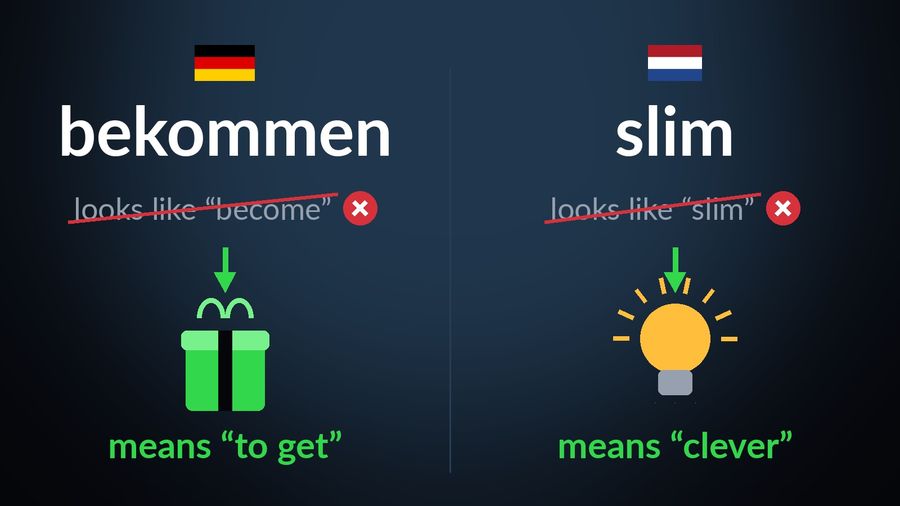
Most everyday nouns line up like the first four rows: recognisable in both languages, often in English too. It is not universal — "window" and "garden" show that German and Dutch can each pick a different root from the other, with neither one obviously closer to English. Both languages also hide false friends behind their more convenient cognates: German bekommen looks like "become" and means "to get", and Dutch slim looks like "slim" and means "clever". Those and more are covered in why German vocabulary is the easy part and why Dutch vocabulary tricks English speakers fastest.
Which one fits your goal
German is an official language of Germany, Austria, Switzerland, Liechtenstein and Luxembourg, and one of Belgium's three official languages, with roughly 95 million native speakers concentrated in central Europe. Dutch is official in the Netherlands, Belgium (Flanders), Suriname, Aruba, Curaçao and Sint Maarten, with about 25 million native speakers. If your reason to learn either one is a specific country — a job posting in Munich, a move to Amsterdam, family in Suriname — that answer usually settles it faster than any difficulty ranking. If the reason is broader, German reaches more countries and more native speakers; Dutch gets you speaking sooner, and its speakers are famously quick to switch to English the moment you hesitate, which is its own kind of obstacle worth knowing about going in. For a longer look at how much vocabulary either goal actually takes, see how long it takes to learn German and how long it takes to learn Dutch.
Learning one after the other
Neither language is wasted effort toward the other. Someone who learns German first arrives at Dutch with the harder half already behind them: no case system to unlearn, a gender split that has shrunk from three categories to two, and a large share of vocabulary already recognisable. Someone who starts with Dutch gets to German with the reading vocabulary largely in place and the shared verb-second habit already automatic, leaving the case system as the one genuinely new piece of grammar to add. Either order beats starting from nothing twice, precisely because the overlap covered above — the shared word order, the shared roots, the shared pool of false friends to watch for — carries over directly.


Watch Your Language teaches German and Dutch as two of its 25+ languages, in the same base dictionary form covered on this page, brought back to your iPhone Lock Screen and Apple Watch face on a schedule built around the words you are actually forgetting. Whichever one you start with, and if you later add the other, your own words — from a menu, a work document, or a photo of your notes — go on the same list as the pre-made packs.