 Paul L.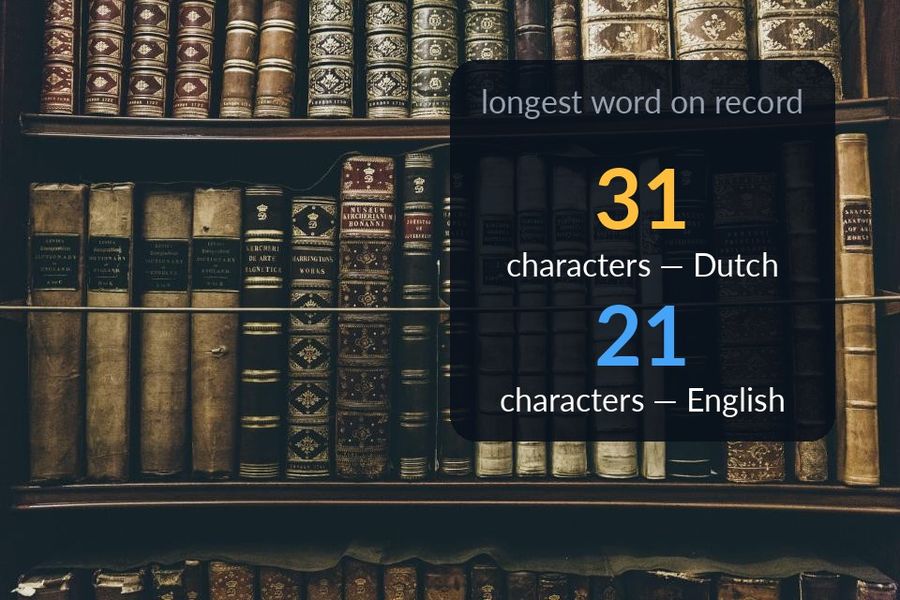
Every language in Watch Your Language's word lists has its own longest entry, and the differences are not random. Some languages build one long word out of several short ones; others say the same thing with three or four separate words and stay short. Looking at the single longest word recorded for each language the app teaches shows both patterns at once.
The longest single word in the data is Dutch: producentenverantwoordelijkheid, "product stewardship," at 31 characters. German and Swedish are close behind at 29 characters each, and Finnish and Norwegian follow at 28. English's own longest entry, psychoneuroimmunology, comes in at 21 characters — a word French, Polish, Latin, Hindi and Esperanto also use, in only slightly different spellings, because it is an international scientific term rather than a word any one language built on its own.
Key takeaways
- The longest word in the word lists is Dutch producentenverantwoordelijkheid (31 characters); German and Swedish follow at 29, Finnish and Norwegian at 28.
- Length reflects structure: German, Dutch and Scandinavian languages join nouns, Turkish and Finnish stack endings, and others use short phrases.
- A long compound is still one vocabulary item, so judge difficulty by how often you meet it, and add technical words you run into as your own.
The longest word in each language
The table below shows the longest single word — no spaces, no hyphenated phrase — recorded for each language in the app's word lists, along with what it means and how many characters long it is. Chinese, Japanese and Thai (marked *) do not mark word boundaries with spaces the way English does, so their entries are really the longest unbroken run of characters rather than a single word in the same sense. Vietnamese (also marked *) does the opposite: it writes a space after every syllable, so an ordinary multi-syllable Vietnamese word looks, by this measure, shorter than it is.
| Language | Longest word | Meaning | Characters |
|---|---|---|---|
| Arabic | الأنجلوسكسونية | Anglo-Saxon | 14 |
| Bengali | নিষ্ক্রিয়-আক্রমণাত্মক | Passive-aggressive | 22 |
| Chinese* | 同父异母的兄弟姐妹 | Half-sibling | 9 |
| Danish | repræsentativitetsheuristik | Representativeness heuristic | 27 |
| Dutch | producentenverantwoordelijkheid | Product stewardship | 31 |
| English | psychoneuroimmunology | Psychoneuroimmunology | 21 |
| Esperanto | psikoneŭroimunologio | Psychoneuroimmunology | 20 |
| Finnish | kyberturvallisuusanalyytikko | Cybersecurity analyst | 28 |
| French | psychoneuroimmunologie | Psychoneuroimmunology | 22 |
| German | Rechtsanwaltsfachangestellter | Paralegal | 29 |
| Greek | διατροφογονιδιωματική | Nutrigenomics | 21 |
| Hebrew | דֵּקוֹנְסְטְרוּקְטִיבִיזְם | Deconstructivism | 26 |
| Hindi | साइकोन्यूरोइम्यूनोलॉजी | Psychoneuroimmunology | 22 |
| Indonesian | mengontekstualisasikan | To contextualize | 22 |
| Italian | internazionalizzazione | Internationalization | 22 |
| Japanese* | コンタクト・インプロビゼーション | Contact improvisation | 16 |
| Korean | 나이아신아마이드 | Niacinamide | 8 |
| Latin | psychoneuroimmunologia | Psychoneuroimmunology | 22 |
| Norwegian | representativitetsheuristikk | Representativeness heuristic | 28 |
| Polish | psychoneuroimmunologia | Psychoneuroimmunology | 22 |
| Portuguese | desproporcionalmente | Disproportionately | 20 |
| Spanish | desproporcionadamente | Disproportionately | 21 |
| Swedish | rekommendationsmarknadsföring | Referral marketing | 29 |
| Tagalog | nakapagbibigay-inspirasyon | Inspiring | 26 |
| Thai* | อคติในการเข้าใจถึงปัญหาหลังเหตุการณ์ | Hindsight bias | 36 |
| Turkish | nicelleştirilebilir | Quantifiable | 19 |
| Ukrainian | об'єктно-орієнтований | Object-oriented | 21 |
| Vietnamese* | mise-en-scène | Mise-en-scène | 13 |
Several languages land on the same entry by coincidence rather than by sharing a structure: French, Polish, Latin, Hindi and Esperanto join English at psychoneuroimmunology, because specialised scientific vocabulary of this kind tends to spread between languages largely unchanged, rather than get rebuilt from native word parts each time.
Why some languages build one long word
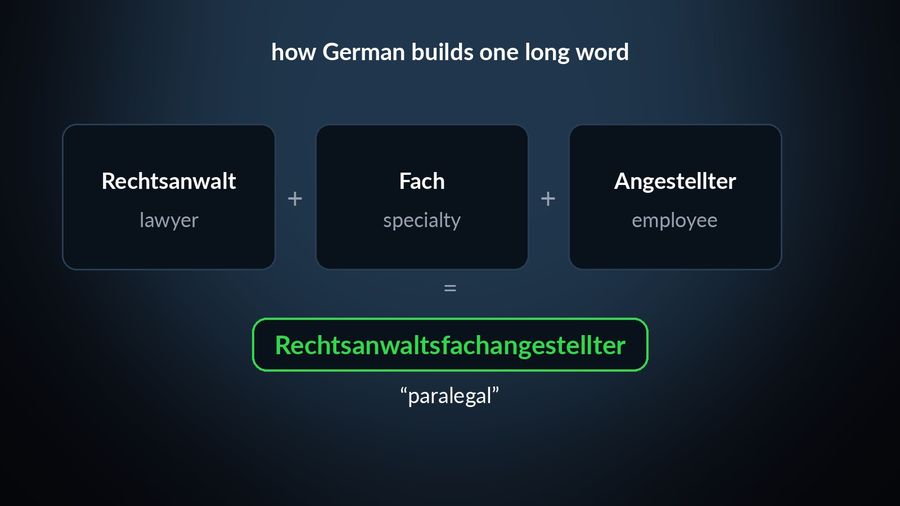
German and Dutch share a trick: they build new nouns by joining existing ones directly together, with no space and no hyphen. Rechtsanwaltsfachangestellter, German for "paralegal," is built from Rechtsanwalt (lawyer), Fach (specialty) and Angestellter (employee) — literally a law firm's specialised employee. Dutch does the same thing: producentenverantwoordelijkheid joins producenten (producers) and verantwoordelijkheid (responsibility). It is not a party trick reserved for the famously long examples that circulate as jokes; it is the ordinary way these languages add a word for a new concept, which is also why compounds keep growing as the concepts they describe get more specific.
Danish, Norwegian and Swedish compound the same way, which is why they also sit near the top of the table: Danish repræsentativitetsheuristik and Norwegian representativitetsheuristikk both build "the heuristic of representativeness" out of the same pieces German would use. If compounds like these are the vocabulary you are working through, the app's German word list and Dutch word list have more of them.
Agglutination: one stem, several endings stacked on
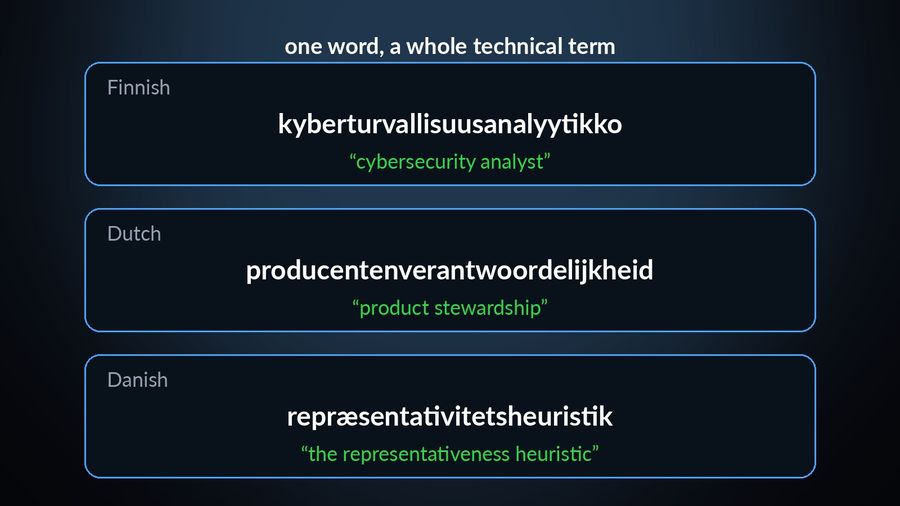
Turkish and Finnish are usually grouped with Korean and Japanese as agglutinative languages: instead of joining whole words, they attach a chain of short endings to a single stem, and each ending adds one piece of meaning. Turkish nicelleştirilebilir, "quantifiable," starts from nicel ("quantitative") and stacks on endings that mean "turn into," "be made to," "can be done" and a closing tense marker — several pieces of meaning riding on one stem. Finnish does both things at once: kyberturvallisuusanalyytikko ("cybersecurity analyst") is a compound of kyber, turvallisuus and analyytikko, and a case ending could still be attached on top of that if the sentence needed one.
Korean shows a related instinct on a smaller scale. Rather than coin a new native compound for every borrowed idea, it often takes the loanword whole and adds a Korean verb-forming ending: 마리네이드하다, "to marinate," is the borrowed word "marinade," written phonetically, plus -하다, the ending that turns a noun into "to do that thing." The result is agglutination built on an imported stem instead of a native one. See more of it in the app's Turkish word list and Korean word list.
When the same idea stays several words
Not every language turns a concept into one word, even when German or Dutch would. "Work-life balance" is a good example: the app's German entry, Work-Life-Balance, is the English phrase itself, borrowed whole and hyphenated into a single unit rather than built from German parts. Spanish (equilibrio entre trabajo y vida personal), Italian (equilibrio tra lavoro e vita privata), Portuguese (equilíbrio entre vida pessoal e profissional), Danish (balance mellem arbejde og privatliv), Norwegian (balanse mellom arbeid og privatliv) and Greek (ισορροπία επαγγελματικής και προσωπικής ζωής) all spell the same idea out as a short phrase instead. There is no rule that a concept becomes one word in every language that is capable of compounding — it depends on whether that particular idea happened to get compounded, borrowed whole, or just left as a phrase.
What this means for building a vocabulary list
None of this makes a language's vocabulary harder to learn in bulk — a 31-character Dutch compound is still one vocabulary item, not four. It does mean that judging how "big" a word is by its letter count says more about whether that language compounds, agglutinates or stays analytic than about how hard the word is to remember. This app is a passive-vocabulary tool, not a grammar course, so it will not teach you when Turkish reaches for -ebilir or when German joins two nouns together; a structured course or a grammar reference is the better fit for that. What it does do is keep whichever words you are learning coming back on a schedule set by how well you know them — see how that scheduling works and why passive exposure suits vocabulary specifically.
The words in this table are also a reminder that a vocabulary list is never really finished. Technical terms like "cybersecurity analyst," "product stewardship" or "the representativeness heuristic" are exactly the kind of word a general course is unlikely to cover, and exactly the kind you might meet once, in one document, and need to remember. Because Premium lets you add your own words — typed in, imported from a spreadsheet, or captured from handwritten notes with the camera — a long or unusual word you actually ran into does not have to wait for a pre-made pack to catch up with it. You can also see where your own vocabulary stands with the free vocabulary level test.


Watch Your Language shows one word at a time on your iPhone Lock Screen and Apple Watch face, so a compound like producentenverantwoordelijkheid takes no more of your attention than a short one — it is a single vocabulary item, brought back on the schedule set by how well you know it. On watch faces with less room, tap the complication to see the rest of a long word; Extra Large and Modular fit long entries most comfortably. If the long or technical word you want to learn is not part of a pre-made pack, Premium lets you add it yourself, including by photographing it from your own handwritten notes.