 Paul L.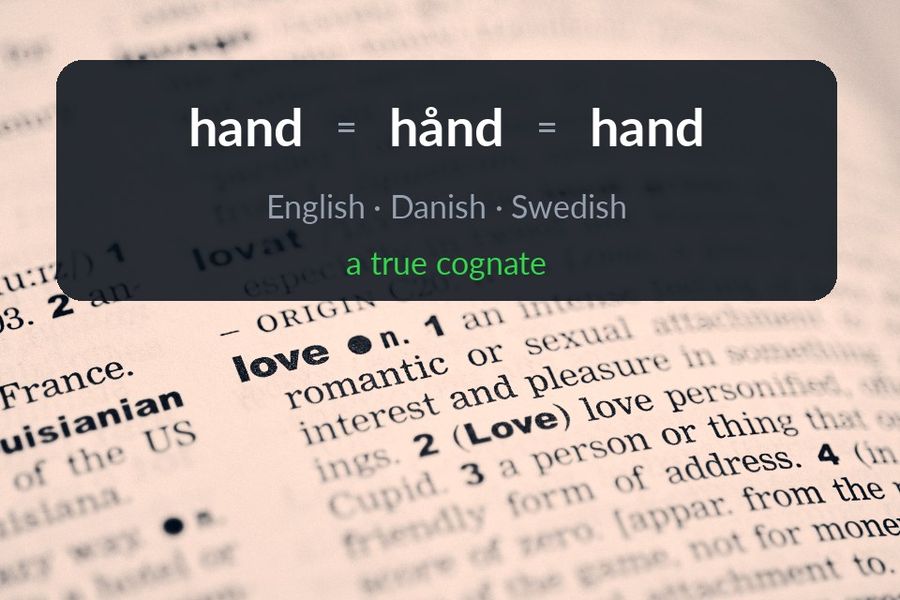
A cognate is a word that already looks like the one you know: hand in Danish is hånd, in Swedish it is hand, and you can read both without a translation. Not every look-alike earned its resemblance the same way, though, and the languages the app teaches do not share that resemblance with English evenly. Comparing their everyday vocabulary puts a rough order on which languages hand you the most words for free, which ones hide a false friend inside the free word, and which ones offer almost nothing to lean on at all.
Key takeaways
- True cognates are inherited, loanwords like coffee are borrowed, and false friends like actuel (current, not actual) look English but differ in meaning.
- French and the Germanic languages (Danish, Dutch, German, Norwegian, Swedish) share the most everyday vocabulary with English; non-Latin scripts share little in spelling.
- Recognising a cognate is not owning it: learn false friends deliberately and review lookalikes with spaced repetition until recall sticks.
True cognates, loanwords and false friends are three different things
A true cognate is a word two languages both inherited from a shared ancestor, rather than one borrowing it from the other. English and its Germanic relatives are full of them: hand is Hand in German and hånd in Danish and Norwegian, water is Wasser in German and water in Dutch, father is Vater in German and far in Danish, Norwegian and Swedish. These words did not travel from one language to the other; German, Dutch, Danish, Norwegian, Swedish and English all inherited them from the same Germanic root, and the family resemblance never faded.
A loanword is different: one language picked the word up wholesale from another, usually along with whatever it named. Coffee is the textbook case — English took it from Dutch koffie, which took it from Turkish kahveh, which took it from Arabic qahwah, as the word's own etymology traces out, and versions of the same word now sit in dozens of unrelated languages, including several of the app's own: Kaffee in German, kaffe in Danish, Norwegian and Swedish. It looks like a cognate on the page. It is really a well-travelled loan.
A false friend is the dangerous one: a word that looks like an English word but means something else. The app's own word lists show a tidy example — ask for the translation of current and French gives actuel, Spanish gives actual, German gives aktuell, Italian gives attuale, Portuguese gives atual. All five mean “current” or “present-day”, not “actual” in the English sense of “real”. Spot actuel or actual in a sentence and the resemblance to English all but guarantees a first misreading, in five languages at once. The app's own deep dives into Dutch and German vocabulary cover more of these by language, including why Gift means poison in German rather than a present, and why Dutch slim means clever rather than thin.
Which of the app's languages share the most with English
Ranked by how much of their everyday vocabulary looks like English, French and the Germanic languages — Danish, Dutch, German, Norwegian and Swedish — come out ahead of the rest: French because a large share of English vocabulary, by various estimates, traces back to French, most of it absorbed after the Norman Conquest of 1066, the other five because they are, like English, Germanic languages that never stopped resembling each other. The app's own deep dive into Swedish covers that closeness from the other direction.
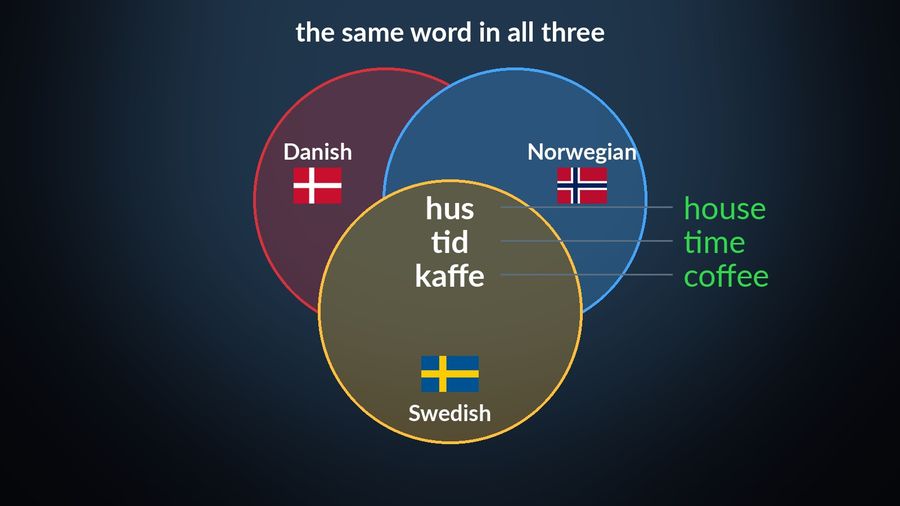
Those same Germanic languages are closer to each other than any of them is to English. Danish, Norwegian and Swedish in particular overlap more with one another than with anything else in the comparison: hus is house in all three, tid is time in all three, kaffe is coffee in all three. A Danish speaker reading Norwegian, or a Swedish speaker reading Danish, is working with a far shorter list of surprises than an English speaker is with any of the three.
Below that top tier sits a second cluster built on Latin rather than a shared Germanic root: Latin itself, Italian, Portuguese and Spanish, each carrying a solid stock of words English also took from Latin directly or through French, alongside Indonesian, which uses many of the same international words — museum, data and visa are spelled the same in Latin, Indonesian and English. A third, more modest tier — Polish, Turkish, Finnish, Vietnamese and Esperanto — mostly shares newer, internationally travelled vocabulary rather than a deep historical connection: Polish and Turkish both keep test and tablet unchanged from English, for example, the kind of word that moves between languages within a generation rather than over centuries. Esperanto's showing here is by design rather than accident: its vocabulary was deliberately drawn primarily from Romance languages, with substantial contributions from Germanic ones, when its modern form was published in 1887.
One language jumps the whole ranking for a reason that has nothing to do with ancestry: Tagalog. Filipino speakers routinely drop English words into everyday Tagalog sentences rather than translating them, a well-documented habit linguists call Taglish, and the app's own Tagalog word list reflects it — email, password, deadline, stakeholder and download all appear in Tagalog exactly as they do in English. That is not a cognate in the sense the rest of this ranking measures; it is a living language absorbing English words directly, in real time, rather than having shared them with English for a thousand years.
At the bottom of the comparison sit the languages written in a different script — Arabic, Bengali, Chinese, Greek, Hebrew, Hindi, Japanese, Korean, Thai and Ukrainian — where a comparison of spelling finds little to match. That is a limit of comparing spelling, not a sign these languages owe English nothing: sugar came to English through Old French and Medieval Latin from Arabic sukkar, which took it from Persian, which took it from Sanskrit, as the word's own etymology shows. A shared history does not always leave a shared spelling behind.
Reading a cognate is not the same as owning it
Recognising restaurant, hotel or bus the first time you see them in French, Danish or Dutch costs nothing — that is the genuine head start a close language gives an English speaker. Testing how far that head start actually goes is worth doing before assuming it: the French vocabulary test and the Dutch vocabulary test both measure what you already recognise rather than what you have studied. False friends do not show up on that kind of test the same way, because a wrong guess that feels obviously right does not feel like a gap — it feels like a fact. That is exactly why actuel, Gift or slim are worth learning deliberately as their real meaning, rather than filed away as a word already known.
Turning a lookalike into a word you keep
A cognate gets past recognition on the first meeting; it does not get to recall a week later without help, and a false friend actively works against you until it is corrected once and remembered correctly after that. Spaced repetition, explained here, is built for exactly that kind of word: one you technically already know but have never actually been tested on, brought back more often until it stops needing a second guess.
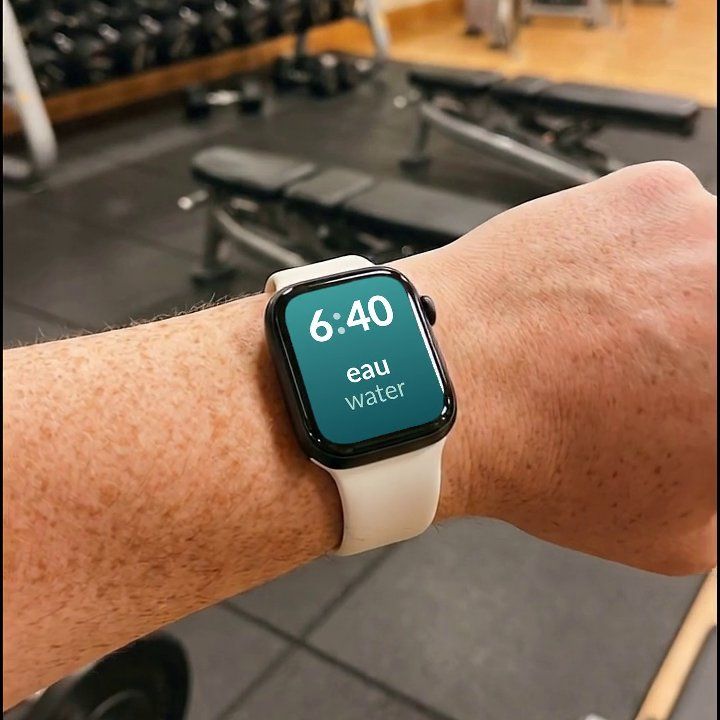

Watch Your Language puts whichever words are being worked on — a batch of French cognates, a list of German false friends, or vocabulary from any of its 25+ languages — on the iPhone Lock Screen, Home Screen and Apple Watch face, scheduled by how often each one is actually recalled correctly rather than by how familiar it looks on the page. With Premium, words can be typed in, imported from a spreadsheet, or added by scanning handwritten notes with the camera, so a lookalike worth double-checking goes straight into a personal review list.