 Eleanora R.
You do not need a whole language before a trip, you need the words you will actually use in the situations a traveller runs into: greeting someone, asking a price, finding a platform, ordering food, asking for help. Aim to start a few weeks before you leave, learn that vocabulary in the situations below, and practise it a little every day rather than all at once the night before you fly.
Key takeaways
- Start three to four weeks before you leave and review a little daily; short daily exposure beats one long session the week before.
- Focus on situations: greetings, numbers, directions, transport, food, shopping and emergencies, with examples like bonjour, hola and こんにちは.
- Say words aloud, since recognising combien on a screen differs from producing it, and scan notes you jot down on the trip into the app.
How early to start
There is no single day on which a word becomes permanent, and this page will not invent one. What is well understood is the shape of it: a word reviewed once and left alone fades quickly, while the same word met again right as it starts to fade moves it toward long-term memory. That is the mechanism behind spaced repetition scheduling, explained in full in our guide to spaced repetition, and it is also why a few weeks of short, daily exposure beats one long session the week before departure. A greeting or a number seen once in a phrasebook on the plane is easy to lose by baggage claim; the same word seen daily for three or four weeks beforehand has a much better chance of coming out on its own when you need it.
Daily does not mean studying. Passive exposure, a word appearing on a screen you already glance at, works for this kind of list precisely because a trip's vocabulary is short and situational rather than grammatically demanding: you are not building sentences, you are recognising and recalling single words and short phrases under mild pressure at a counter or a till.
The vocabulary that actually gets used on a trip
Guidebooks tend to list vocabulary by topic without saying which topics come up the most. In practice, a short trip runs through the same handful of situations regardless of destination. A few examples below are given in French, Spanish and Japanese, so you can see how the same short list looks across a Latin-script and a non-Latin-script language.
Greetings and courtesy
The words that open and close almost every interaction, with a stranger behind a counter as much as with someone you have just met.
- hello — French bonjour, Spanish hola, Japanese こんにちは
- please — French s'il vous plaît, Spanish por favor, Japanese お願いします
- thank you — French merci, Spanish gracias, Japanese ありがとう
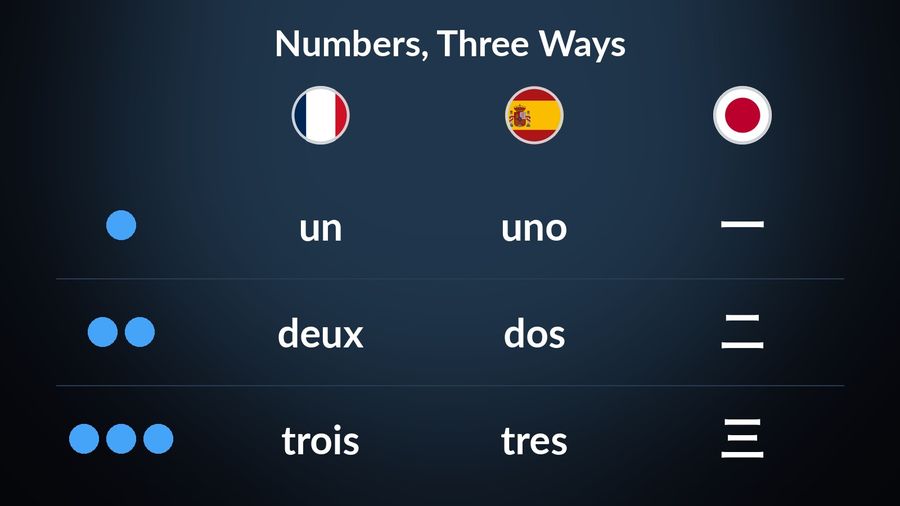
Numbers
For prices, platform numbers, room numbers and departure times. Learning to recognise numbers by ear, not only on a screen, is worth the extra effort, since most of the moments you need them are spoken.
- one — French un, Spanish uno, Japanese 一
- two — French deux, Spanish dos, Japanese 二
- three — French trois, Spanish tres, Japanese 三
Directions
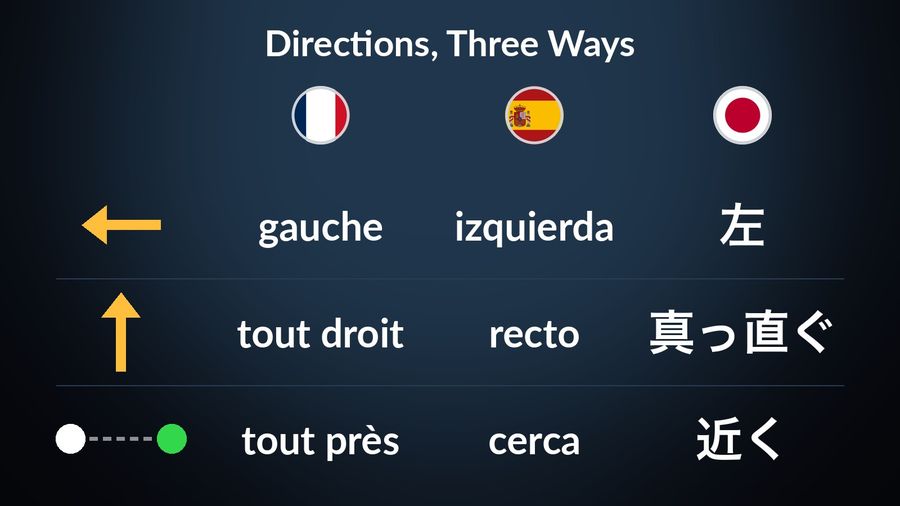
Airport and station signage is often bilingual, but the person you stop on the street to ask is not. A small set of direction words goes a long way further than a map app with no signal.
- left — French gauche, Spanish izquierda, Japanese 左
- straight — French tout droit, Spanish recto, Japanese 真っ直ぐ
- nearby — French tout près, Spanish cerca, Japanese 近く
Transport
The words that get you from the airport to wherever you are actually staying, and back again.
- taxi — French taxi, Spanish taxi, Japanese タクシー
- ticket — French billet, Spanish boleto, Japanese 切符
- train — French train, Spanish tren, Japanese 電車
Food and ordering
Reading a menu is one skill; asking for water, flagging a dietary need or asking for the bill is a different, smaller one, and it is the one that comes up at every single meal.
- water — French eau, Spanish agua, Japanese 水
- delicious — French délicieux, Spanish delicioso, Japanese 美味しい
- bill — French addition, Spanish cuenta, Japanese お会計
Shopping
Asking a price and understanding the answer is the exchange that repeats most often outside a restaurant.
- how much — French combien, Spanish cuánto, Japanese いくら
- price — French prix, Spanish precio, Japanese 価格
- cheap — French bon marché, Spanish barato, Japanese 安い
Emergencies
The words you hope not to need, which is exactly why they deserve to be familiar before you leave rather than looked up while you need them.
- emergency — French urgence, Spanish emergencia, Japanese 緊急
- help — French aider, Spanish ayudar, Japanese 助ける
Watch Your Language's word packs are organised the same way: there are packs on travel, transport, airports, hotels, food and shopping, and on emergencies, each graded from beginner to advanced, alongside the packs for everyday topics that are not specific to a trip. Picking the travel-related ones before a trip, rather than working through the app's full catalogue, keeps the list focused on what you will actually say.
Practical steps
A short, situational list like the one above works best handled deliberately rather than left to chance:
- Start three to four weeks out. That gives daily, short exposure time to work, rather than compressing everything into the days before departure, when packing and logistics already compete for attention.
- Group words the way you will use them — a greeting, a direction, a menu word — rather than alphabetically. You will need them in those groups, in that order, at the counter.
- Say the word out loud, not just silently. Recognising combien on a screen and producing it at a market stall are different skills, and the second only comes from practising it.
- If your destination's script is not Latin, learn to read the numbers and a handful of signage words in that script rather than relying on a romanised version throughout. Watch Your Language shows a transliteration alongside scripts such as Japanese, Korean and Chinese, which helps while the script itself is still new.
- If you jot down new words in a notebook while you travel — a menu item a waiter explains, a sign you had to ask about — the app's camera capture turns handwritten notes into flashcards afterwards, so the vocabulary you pick up on the ground does not stay stuck in a notebook.
None of this replaces actually learning the language if that is your goal. Watch Your Language is a vocabulary tool: it does not teach grammar, and it will not get you through a conversation about anything beyond the situations above. For that, a structured course with grammar and speaking practice is the right tool. For getting comfortable with the words a trip actually requires, in the weeks you have before you leave, a short, well-chosen list reviewed daily gets you further than a phrasebook skimmed on the plane.
Related reading
For a broader starting list rather than a travel-specific one, see the most common words to learn first. To check your current level in a language before you decide how much to learn, the vocabulary level test is a quick way to see where you stand, and the French and Spanish word lists cover each language in more depth than a single trip needs.
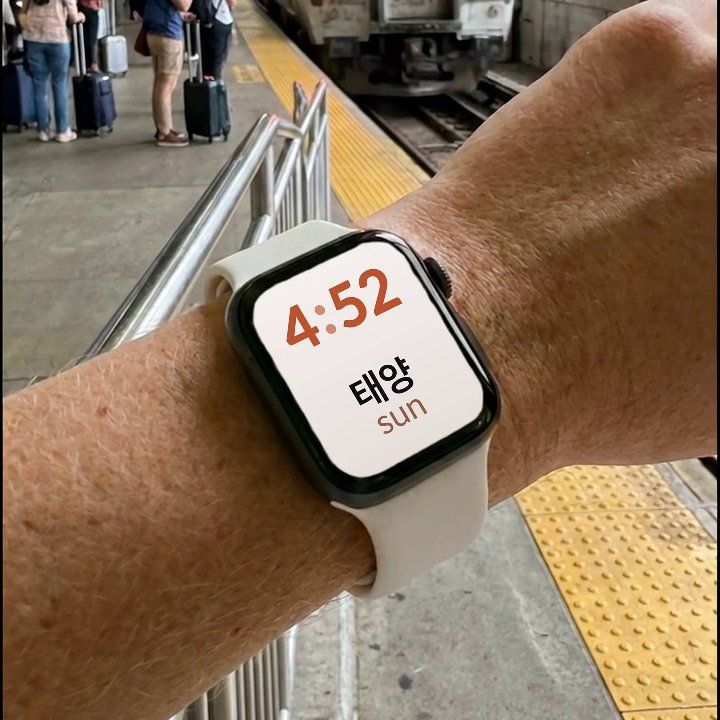
Watch Your Language puts a travel word list on your iPhone Lock Screen and Home Screen, and on your Apple Watch face as a complication, so the greetings, numbers and menu words above show up on their own in the weeks before you leave. You choose how often a word changes, and the app brings back the ones you are still forgetting more often than the ones you already know — no lesson to open, and nothing left to cram at the gate.