 Eleanora R.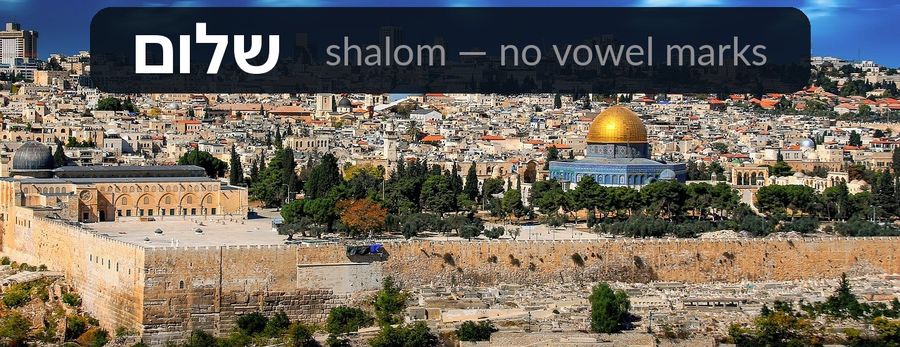
Open an Israeli newspaper, a novel, or most street signage, and the Hebrew on the page carries no vowel marks at all — just the consonants. That is not a simplification for beginners; it is how literate adults read the language every day. Hebrew can do this because it was built to: the script marks consonants primarily, a handful of its letters double up as long-vowel stand-ins, and a reader who knows a word's root recognises the shape before sounding out a single vowel. Vowel marks, called niqqud, still exist and are still printed — just mostly in the places where guessing would be a problem.
Key takeaways
- Hebrew print usually omits vowel marks (niqqud); readers rely on three-consonant roots, context and letters like vav and yud that stand in for vowels.
- One root makes a family: s-p-r gives sefer (book), sofer (writer), sifria (library), mispar (number), lispor (to count) and sipur (story).
- Learn the five final-form letters together, learn roots as families, and use romanisation as a check rather than a crutch.
How the script works
In its traditional form, Hebrew is what linguists call an abjad: an alphabet built from consonant letters, with vowels marked separately or not marked at all, written right to left (Wikipedia, "Hebrew alphabet"). שלום (shalom, "hello" or "peace") is written with four consonant letters and no vowel signs; a reader supplies the two a and o sounds from having seen and heard the word many times before.
Five of the twenty-two letters change shape at the end of a word: kaf, mem, nun, pe and tsadi each have a separate final form, called sofit (Wikipedia, "Hebrew alphabet"). The word for "water", מים (mayim), shows both forms of the same letter in one word: an ordinary mem (מ) opens it, and a final mem (ם) closes it. Once the five final letters are familiar, spotting where one word ends and the next begins is mostly automatic, since Hebrew also separates words with spaces, the way English does.
Niqqud, and when it still appears
Niqqud is the system of small dots and lines placed above, below or inside a consonant letter to mark its vowel. In today's Israeli publishing, niqqud is mainly kept for dictionaries, poetry, and texts written for children or for new immigrants still learning to read (Wikipedia, "Niqqud") — the same category, roughly, that a language learner falls into. Everywhere else — news sites, novels, road signs, most of what a fluent reader sees in a day — the vowel marks are simply left off, and the reader is trusted to supply them.
Watch Your Language's own Hebrew word cards use both conventions: many show the bare consonantal spelling that most Hebrew text uses, and some carry niqqud. Either way, a romanisation sits beside the word, so the reading is never left to guesswork alone.
How readers manage without it
Roots and patterns carry meaning before the vowels do
Most Hebrew words are built from a three-consonant root, stripped of vowels, that carries a core meaning, combined with a fixed pattern of vowels and extra letters that turns it into a verb, a place, a person or a thing (Wikipedia, "Semitic root"). The root ס-פ-ר (s-p-r) is a working example straight from Watch Your Language's own word list: ספר (sefer) is a book, סופר (sofer) is a writer, ספרייה (sifria) is a library, מספר (mispar) is a number, לספור (lispor) is "to count", and סיפור (sipur) is a story. None of that is coincidence. A book is a thing you count pages or words in; a writer is the one who tells the story; a library is where the books live. Learning those six words is really learning one root and five shapes it takes.
This is the same mechanism Arabic vocabulary runs on, because Hebrew and Arabic are both Semitic languages that inherited it from a shared ancestor. The clearest case is the root for "write": Hebrew כ-ת-ב gives כתב (he wrote), כותב (writer) and מכתב (letter), and Arabic ك-ت-ب gives the cognate kataba, kitab and katib — kitab being Arabic for "book" (Wikipedia, "K-T-B"). Hebrew's own word for "book", sefer, breaks off onto a different root instead, which is a useful reminder that two related languages can share a whole system without agreeing on which root does which job.
Context fills in what the letters leave open
A bare consonant skeleton can match more than one word. אמץ, written without niqqud, could be ometz ("courage") or immetz ("he adopted"); the sentence around it settles which one is meant (Wikipedia, "Hebrew spelling"). Modern Hebrew publishing also leans on a formal spelling convention, standardised by the Academy of the Hebrew Language, that adds extra letters into unvocalised words specifically to cut down on this kind of ambiguity (Wikipedia, "Ktiv hasar niqqud"). A fluent reader is rarely stuck; a beginner should expect to be, for a while, and to lean on context the way a fluent reader barely notices doing.
A few letters stand in for vowels
Four Hebrew letters — aleph, he, vav and yud — can double as vowel markers even in unvocalised text; grammarians call this use a mater lectionis, Latin for "mother of reading" (Wikipedia, "Mater lectionis"). Vav commonly marks an o or u sound, as in לכתוב (lichtov, "to write"). Yud commonly marks i or e, and can appear twice in a row, as in ספרייה (sifria, "library"). A final he often marks a trailing a, as in the bare spelling of מלה (mila, "word"). None of these four letters is niqqud — they are ordinary consonant letters doing double duty — but they are why an unvocalised Hebrew word is rarely as bare as its lack of dots and lines suggests.
Where to start
- Learn the alphabet with its five final forms together, not as an afterthought. Kaf, mem, nun, pe and tsadi behave differently only at the end of a word, so it is one habit to build, not five extra letters to memorise separately.
- Learn roots as families, not single words. Once ס-פ-ר or כ-ת-ב is familiar, a new word built on it arrives half explained instead of as a fresh item to memorise.
- Start with words you will see constantly. Greetings, numbers and everyday nouns turn up so often that the correct reading gets reinforced before ambiguity has a chance to matter.
- Use a romanisation as a check, not a crutch. Read the script first and confirm against the romanisation, rather than the other way round.
- Expect to lean on context for a while. That is not a sign you are behind — it is how fluent readers handle unvocalised text too, they just do it fast enough not to notice.
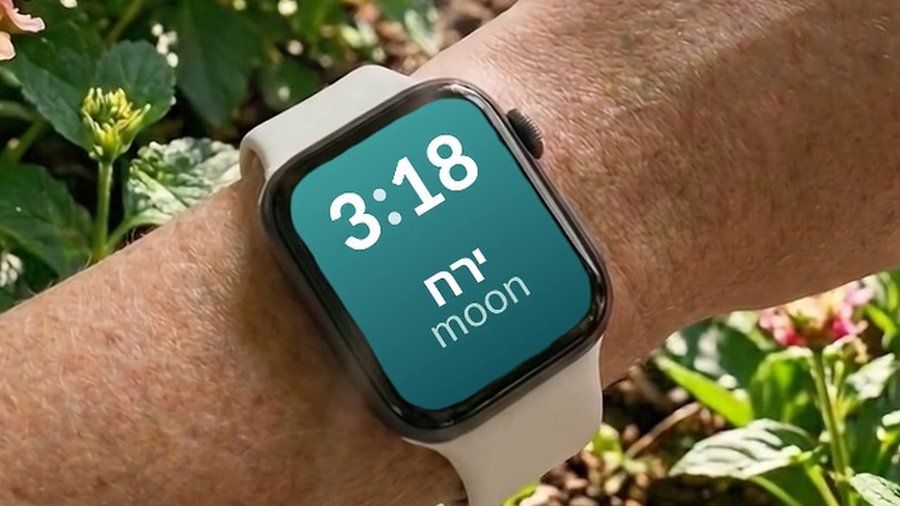

Watch Your Language shows Hebrew vocabulary in script, with a romanisation and a spoken pronunciation beside each word, on your iPhone Lock Screen, Home Screen and Apple Watch face, a few words at a time, and brings back the ones you keep forgetting more often. It will not teach you the root system itself — it is a passive vocabulary tool, not a grammar course — but every word it shows you is a chance to notice the consonants underneath it.
For the same root system worked through in more depth, see how Arabic vocabulary grows from roots, or for a different script solved the same reading-first way, how Devanagari spells Hindi almost exactly as it sounds. To see how many Hebrew words you already recognise, try the Hebrew vocabulary test, and for a rough timeline to your target level, the how long to learn Hebrew calculator.