 Eleanora R.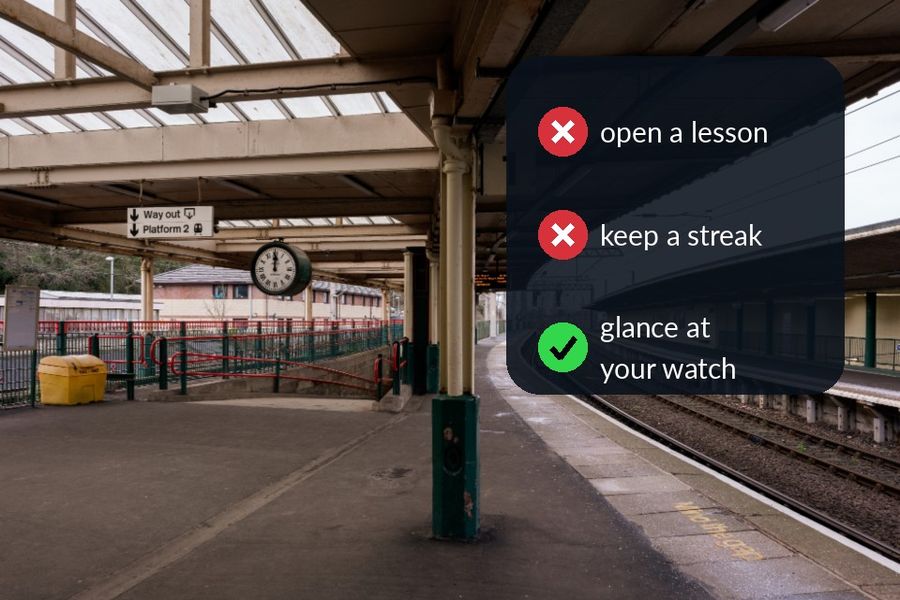
Duolingo is still the default answer to "which app should I use to learn a language?" — free to start, familiar from the owl, and often the first thing anyone downloads. People who move on from it are not all leaving for the same reason, and the right next app depends entirely on which reason is yours. This guide is organised around five of them, based on what each alternative says about itself, on its own site or App Store page, in September 2026.
You are done with the streak and the daily session
If what actually pushed you off Duolingo is the daily session itself — opening the app, doing a lesson, keeping a streak alive — the fix is not a better app to open every day. It is not needing to open one.
Passive exposure — meeting words without a scheduled task — will not teach you grammar or get you speaking, but it is genuinely good at the one thing a daily-session app struggles with: surviving your bad weeks. There is no lesson to skip, so there is nothing to fall behind on.


Watch Your Language is built around exactly this. It puts vocabulary from its 10,000+ words on your iPhone Lock Screen, Home Screen and Apple Watch face, and schedules which word to show next based on the ones you keep forgetting. You choose how often it changes, from every minute to once a week, and there is no lesson to open and no streak to protect. It is a vocabulary tool, not a full course — pair it with one of the options below for grammar or speaking.
The honest limitation: it only builds vocabulary. See also what learning vocabulary without studying can and cannot do — it is a solid foundation, not the whole language.
You want real, useful vocabulary, not a gamified drill
If the issue is not the daily habit but what you get out of it — vocabulary that feels thin, or exercises that reward speed over understanding — Drops is a closer match. It is a vocabulary-only app, not a course: short visual sessions across 55+ languages, with a free tier and a paid Drops Premium that removes the daily time cap and adds offline play.
The limitation is built into the format: the free version gives you a short daily session, and Drops Premium is what removes the time limit. Either way, progress still depends on you opening the app. The session it keeps short, it still asks you to remember.
You want to actually speak the language
No vocabulary app, this one included, teaches you to speak — that takes producing the language out loud, ideally with someone correcting you. italki and Preply are both marketplaces of tutors rather than fixed courses: you choose a teacher and pay for lessons, rather than following an app curriculum.
italki lists 20,000+ teachers across 150+ languages, with no subscription — you pay per lesson at a rate each teacher sets, and can usually book a discounted trial lesson first. Preply is similar in shape, with 100,000+ tutors, though lessons are typically booked as a recurring weekly plan rather than picked one at a time.
The limitation is obvious but worth stating plainly: a tutor costs money and asks you to show up at a set time, which is exactly the friction a passive vocabulary tool removes. If you want speaking practice without booking a person, the AI conversation practice inside Babbel, covered next, is a lower bar than a tutor — and a lower ceiling too.
You want grammar explained, not just practised
Duolingo teaches grammar mostly through practice, with short explanations along the way, which suits some learners and leaves others wanting the rule spelled out first. Babbel and Busuu both take the opposite approach: structured courses with explicit grammar notes alongside the practice.
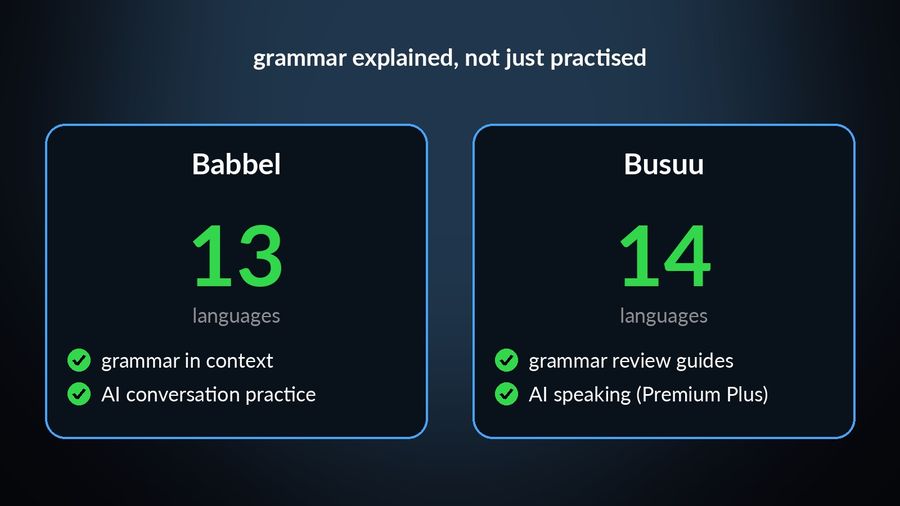
Babbel covers 13 languages for English speakers with lessons built by its language experts, plus AI-partner conversation practice that is free for registered users, and podcasts. Busuu covers 14 languages and adds grammar review guides and, on its top Premium Plus tier, AI-based speaking practice with pronunciation feedback.
The limitation for both: they are courses, which means a curriculum to work through and a session to sit down for — the thing a lot of people are leaving Duolingo to get away from in the first place. They solve the grammar gap, not the daily-session one.
You want to learn from real content, not app-made exercises
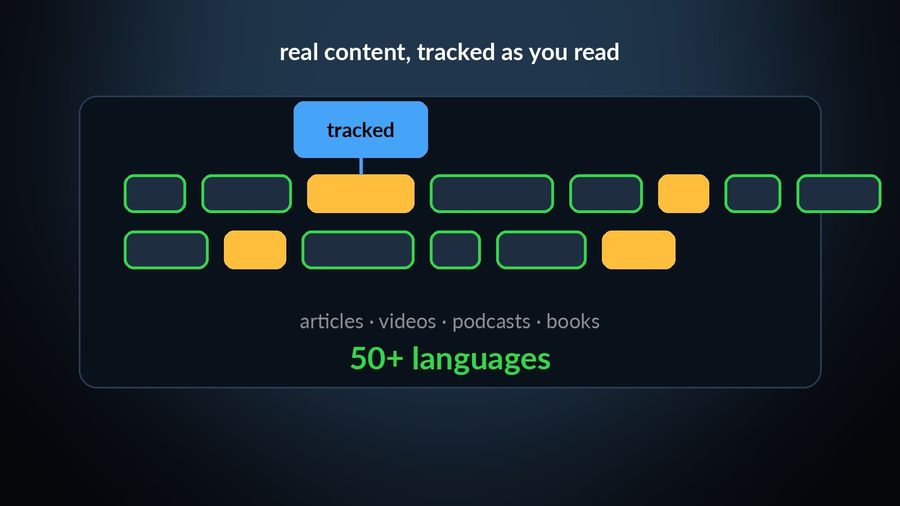
Some people leave not because the app asks too much, but because what it teaches feels disconnected from the language as it is actually written and spoken. LingQ is built around importing real material — articles, YouTube videos, podcasts, books — and turning it into a reading and listening lesson: tap an unfamiliar word, see it in context, and it is tracked and colour-coded the next time it appears.
LingQ covers more than 50 languages on a freemium model, with a paid membership needed for full access to its content library. Outside any single app, plain listening — a podcast made for learners, or one in the language itself once you can follow it — does a similar job of putting real language in front of you; LingQ's advantage is that it tracks what you already know as you go.
The limitation: this is a reading-desk experience, with the app or a browser open and your attention on it, which is closer to studying than to a passive glance. It also works best once you already recognise enough vocabulary to make the words in front of you clickable rather than a wall of unknowns.
Which alternative fits you
None of these replace each other, and many people leaving Duolingo end up combining two: a vocabulary layer that runs in the background, and one active method for the skill it does not cover.
| Why you left Duolingo | Best alternative |
|---|---|
| Streak fatigue, no daily session | Watch Your Language — vocabulary on your Lock Screen and Apple Watch face, no session to open |
| Want real, useful vocabulary | Drops |
| Want to actually speak | italki or Preply |
| Want grammar explained | Babbel or Busuu |
| Want to learn from real content | LingQ |