
 Paul L.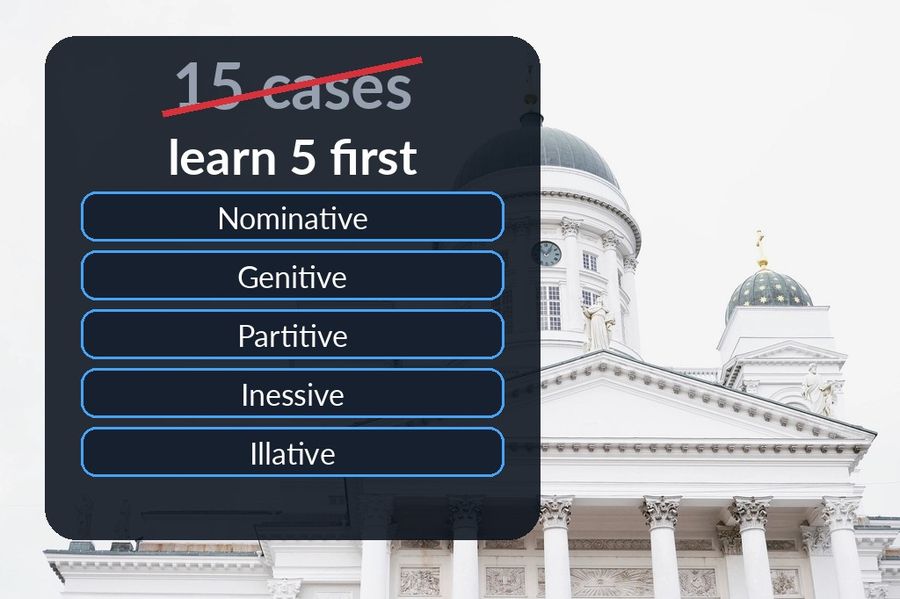
Finnish nouns take fifteen grammatical cases, a fact that travels ahead of the language and tends to scare people off before they have seen a single one. The realistic version is calmer: a handful of those fifteen carry almost all of the weight in ordinary conversation, and the rest can wait. Learn five cases and one pattern each for how their endings change, and you can already follow the shape of most Finnish sentences.
Key takeaways
- Finnish has fifteen cases, but start with five on talo: nominative talo, genitive talon, partitive taloa, inessive talossa (in) and illative taloon (into).
- Two patterns reshape endings: vowel harmony (-ssa vs -ssä) and consonant gradation (kauppa becomes kaupan). Notice them in known words rather than memorising rules.
- Learn each noun's nominative first, then genitive and partitive, then the locative trio; meet the rarer cases through reading and listening.
Fifteen cases, four jobs
Where English mostly uses word order and small words like "in", "to" or "with" to show what a noun is doing in a sentence, Finnish attaches an ending directly to the noun instead. Finnish grammar groups the fifteen resulting cases into four sets: four grammatical cases that mark a sentence's core roles (nominative, genitive, accusative and partitive), six locative cases that come in interior and exterior pairs for "in", "into" and "out of", or "on", "onto" and "from", two cases for a temporary or resulting state (essive and translative), and three marginal cases mostly confined to set phrases and formal writing (instructive, abessive and comitative). None of them is optional the way a formal register might be — an ordinary sentence reaches for several within a single paragraph.
Two things that reshape every ending
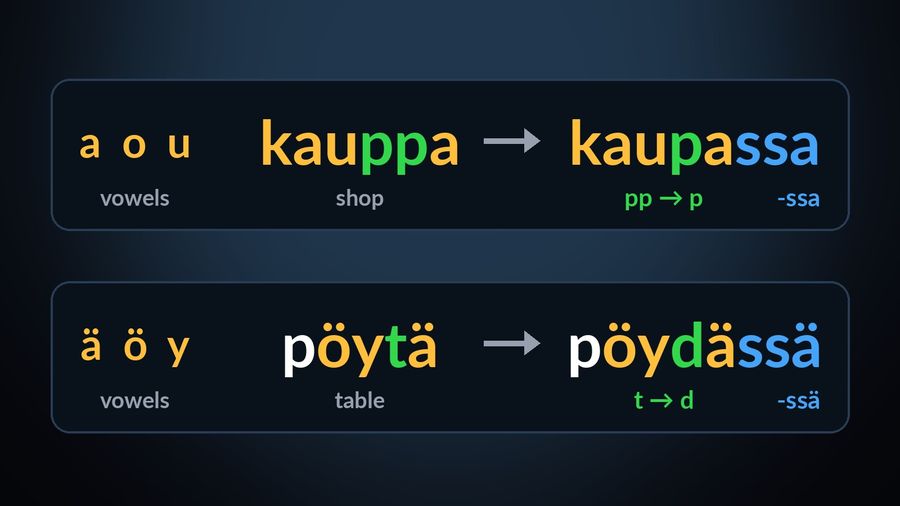
Two patterns explain why a Finnish case ending is rarely just "stem plus suffix" bolted on unchanged. The first is vowel harmony: a word built from back vowels (a, o, u) takes endings with a, while a word built from front vowels (ä, ö, y) takes the front-vowel version of the same ending — the inessive suffix is -ssa after a back-vowel word but -ssä after a front-vowel one. The second is consonant gradation: in many nouns, a consonant near the end of the stem alternates between a "strong" and a "weak" form depending on the case. kauppa ("shop") keeps its double pp in the nominative and illative, kauppa and kauppaan, but weakens to a single p in the genitive and inessive, kaupan and kaupassa — the forms are set out in Wiktionary's declension table for kauppa. A front-vowel noun shows both patterns at once: pöytä ("table") takes the front-vowel ending and gradation together in its inessive, pöydässä, listed in Wiktionary's entry for pöytä. Neither pattern is random: a beginner course teaches both as rules, and most learners end up recognising them by ear well before they could state the rule.
Five cases to learn first
talo, "house," is one of the simplest Finnish nouns to decline: it takes no consonant gradation at all, so the endings below attach to an unchanging stem. The forms and their core use are drawn from Wiktionary's declension table for talo and from the case descriptions in Finnish grammar, which uses this same noun to illustrate the inessive and illative.
| Case | talo ("house") | What it marks |
|---|---|---|
| Nominative | talo | The dictionary form; the subject of a sentence |
| Genitive | talon | Possession — "the house's", "of the house" |
| Partitive | taloa | An incomplete or unspecified amount, and after negation |
| Inessive | talossa | "In" the house — a fixed location inside something |
| Illative | taloon | "Into" the house — movement toward the inside |
A reasonable order to learn them in
This is a learning-order recommendation, not a claim about how often each case turns up in real Finnish — start with the nominative, since it is the form every dictionary, phrasebook and word list gives you first. Add the genitive and partitive next: between them they cover possession, quantity and negation, which are hard to avoid in even a short conversation. The locative trio of inessive, illative and elative ("out of") is worth learning as a group once the first three feel comfortable, because they follow the same vowel-harmony and gradation patterns as each other. The remaining cases — the rest of the locative set, the essive and translative, and the three marginal cases — are worth meeting through reading and listening rather than memorising in advance; several of them barely appear outside written Finnish.
What this means for building a vocabulary list
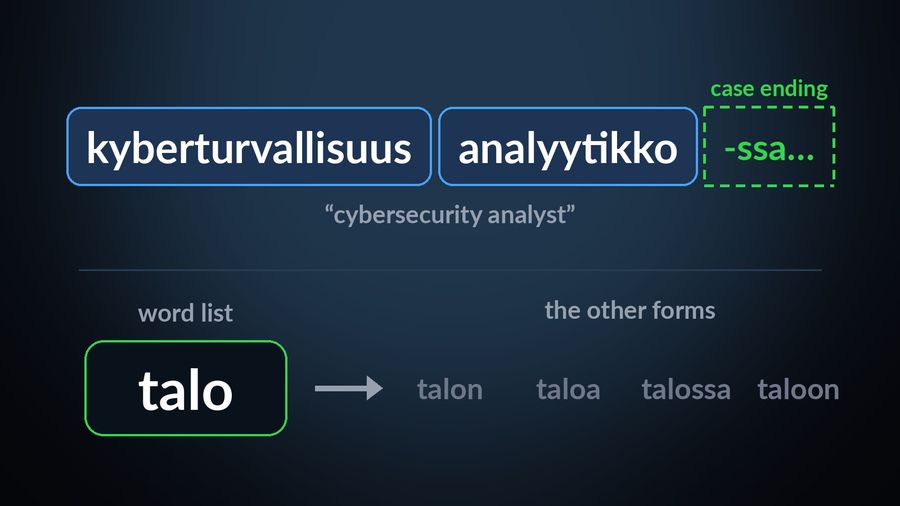
A word list that only ever shows a noun in its nominative form, such as this app's, is showing you the one shape every Finn would also give you if you asked what a word is — and it is honestly not the whole word. That is the same trade-off Polish's seven cases force on a vocabulary list, and the practical fix is the same one: memorise the base form deliberately, then let the other endings arrive through exposure rather than through drilling every form of every noun before you have any words to attach them to. Finnish adds one more wrinkle on top of its cases: it also builds long compound nouns by stringing shorter words together, the way the longest words in the app's 25+ languages shows with kyberturvallisuusanalyytikko, "cybersecurity analyst" — a case ending can still attach to the end of a compound like that one, exactly as it would to a short noun.
Practical steps to start
- Learn each new noun in its nominative form first, the way it appears in a dictionary or a word list, before worrying about how it declines.
- Once a handful of nouns feel familiar, add their genitive and partitive forms — most textbooks introduce these two alongside the nominative for exactly this reason.
- Practise the inessive, illative and elative together on the same nouns, since one vowel-harmony rule and one gradation pattern covers all three at once.
- Notice consonant gradation in the words you already know rather than memorising the rule in the abstract; it becomes predictable faster by ear than on paper.
- Leave the essive, translative and the three marginal cases for when you are reading or listening to real Finnish and meet them in context.
A rough estimate of how long Finnish takes to learn and a short test of your current Finnish vocabulary are both useful before settling on a study plan — cases are a grammar problem on top of a vocabulary problem, and it helps to know which one you are further behind on.


Watch Your Language shows Finnish nouns in their plain nominative form, the same one used throughout this page, because that is the form worth being certain of before the other fourteen. It puts a handful of words at a time on your iPhone Lock Screen and Apple Watch face, and brings back the ones you have not seen in a while, so the vocabulary is already solid by the time you meet it wearing a case ending. This app does not teach grammar or the case system itself — pair it with a Finnish course or grammar reference for that, and let it handle keeping the words themselves from slipping.