
 Eleanora R.

Indonesian is usually the language people recommend to a nervous first-time learner: no verb tenses to memorise, no grammatical gender, Latin letters from the first lesson. All of that is genuinely true, and it makes the first month faster than almost any other big world language. The catch arrives once you try to say more than a beginner sentence, because Indonesian pushes nearly all of its grammar into one place — the prefixes and suffixes attached to a root word — and that system takes real, steady work to learn.
Key takeaways
- Indonesian starts easy (Latin script, phonetic spelling, no tenses, genders or cases), but nearly all its grammar sits in prefixes and suffixes on root words.
- One root, many words: ajar gives belajar (to study), mengajar (to teach), diajar (be taught) and pelajaran (lesson); the wrong affix says the opposite.
- The meN- prefix changes shape by following sound (mengajar, memilih, menulis), so learn roots with an affixed form and by ear.
Why the start really is easy
Indonesian is written in the Latin alphabet, the same one English uses, so there is no new script to learn before you can read a menu or a street sign — its Wikipedia overview lists the writing system simply as Latin. Spelling is phonetic: once you know how the letters sound, you can read a word out loud correctly the first time, with none of English's silent letters or inconsistent vowels.
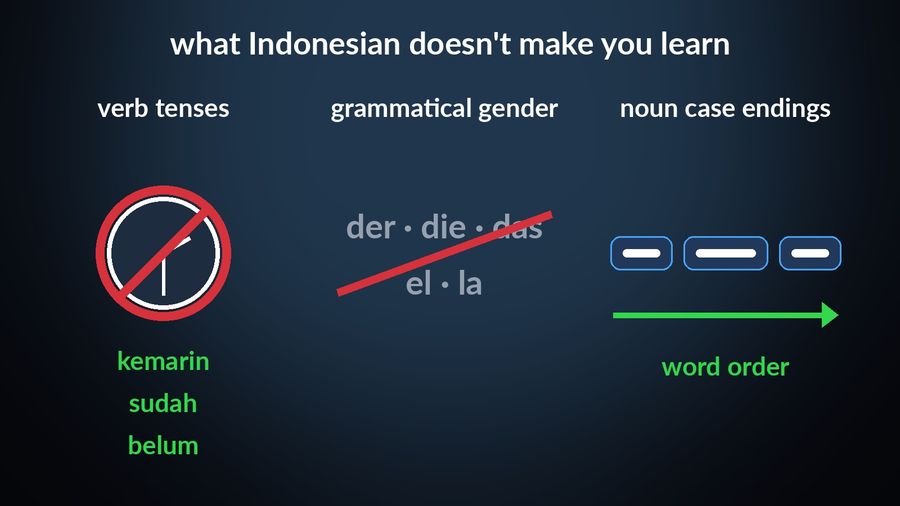
The grammar starts light too. Per Wikipedia's overview of Malay and Indonesian grammar, "verbs are not inflected for person or number, and they are not marked for tense" — instead of conjugating a verb, Indonesian adds a time word such as kemarin (yesterday) or a marker such as sudah (already) and belum (not yet). The same overview notes that the language "does not make use of grammatical gender," so there is no der/die/das or el/la to memorise alongside every noun. Nouns are not declined for case either — a word's role in the sentence comes from word order and prepositions, not from a changing ending, which the same page describes as the language's generally "minimal inflectional morphology."
Where the real grammar lives: the affixes
Indonesian does not skip grammar so much as relocate it. Instead of conjugating verbs or declining nouns, it builds words: a root rarely appears on its own in fluent speech, and which prefix or suffix (or both) you attach decides whether it becomes an active verb, a passive verb, or a noun, and who is doing what to whom. Learning Indonesian vocabulary one root at a time, without also learning its common affixed forms, leaves you able to recognise words in a dictionary and unable to follow a sentence.
A short, well-documented example is the root ajar — "teach" or "instruction" — which turns up on Wiktionary's entry for it in most of the forms below:
| Form | Affix | Meaning |
|---|---|---|
| ajar | root | teach, instruction (rarely stands alone) |
| belajar | ber- | to study, to learn |
| mengajar | meN- (meng-) | to teach (someone) |
| diajar | di- | to be taught |
| ajarkan | -kan | teach it, hand over the teaching |
| ajari | -i | teach him or her |
| pelajaran | pe-…-an | lesson |
| pengajar | peN- (peng-) | teacher, instructor |
Two things are worth noticing in that table. First, belajar (to study) and mengajar (to teach) are two entirely different verbs built from the same three-letter idea — get the affix wrong and you have said the opposite of what you meant. Second, pelajaran (lesson) drops the nasal that pengajar (teacher) keeps: Indonesian's agent-noun prefix mostly follows the same assimilation rule as the verb prefix below it, but a handful of common words, this pair among them, are irregular and have to be learned as themselves.
The shape-shifting prefix: meN-
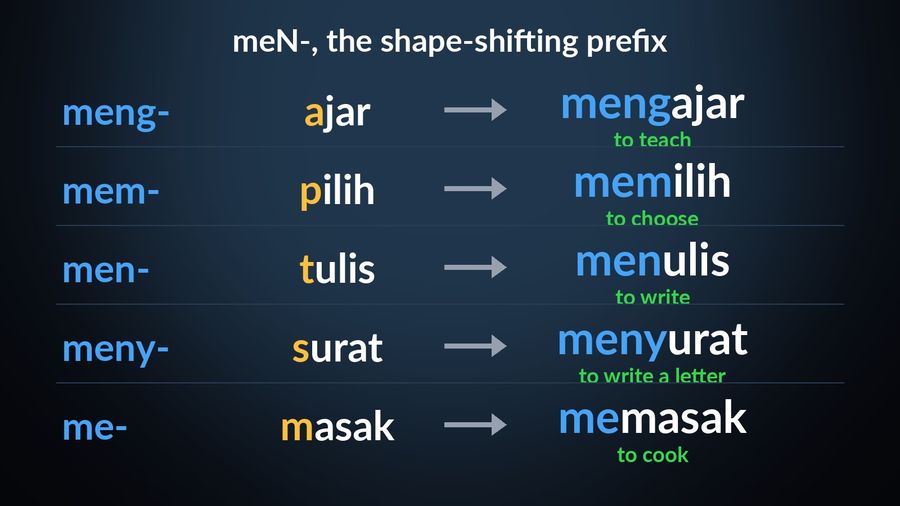
meN- is the prefix that turns a root into an active, "does the action" verb, and it is the one beginners trip over most, because it changes shape depending on the sound that follows it. Per the same Wikipedia grammar overview, the pattern runs:
- meng- before a vowel, or before g, h or k — ajar → mengajar (to teach)
- mem- before b, p or f, usually dropping the root's own p — pilih → memilih (to choose)
- men- before c, d, j or t, usually dropping the root's own t — tulis → menulis (to write)
- meny- before s, dropping the s — surat → menyurat (to write a letter)
- me- before l, m, n, r, w or y, unchanged — masak → memasak (to cook)
The other affixes on the required list do narrower, steadier jobs. ber- makes a root into a stative or "have/do habitually" verb — ajar becomes belajar, to study, rather than to teach. di- turns the same root passive: diajar, to be taught, the mirror image of mengajar. -kan adds a causative or benefactive sense, roughly "make it happen" or "do it for someone" — the same overview gives duduk (sit) → mendudukkan (to seat someone). -i marks a location or a repeated, exhaustive action — jauh (far) → jauhi (avoid, keep away from). And the circumfix ke-…-an wraps a root into an abstract noun or an unintentional event, as in hilang (disappear) → kehilangan (to lose, or "loss").
Practical steps for learning the affixes
- Learn a root with at least one of its affixed forms, not alone. A vocabulary list of bare roots is misleading, since most roots are bound morphemes that rarely stand on their own; pairing ajar with belajar or pelajaran from the first meeting keeps the two facts attached to each other.
- Learn the meN- forms by ear before by rule. The assimilation table above is worth reading once, but fluent recall comes from hearing mengajar, membeli and menulis often enough that the right shape starts to sound correct on its own.
- Ask what changed, not just what was added. Swapping ber- for meN-, or -kan for -i, changes who is doing what to whom — treat each swap as a different word to learn, not a variant spelling.
- Expect this to take real time, and plan around it. The U.S. State Department's Foreign Service Institute groups Indonesian in its Category II, a step above the easiest languages for an English speaker — a fair reflection of a language that starts fast on vocabulary and script, then asks for sustained practice on exactly the affix system above.


Watch Your Language does not teach meN- or ber- — it is a passive vocabulary tool, not a grammar course. What it is good for here is keeping a root and its everyday derived forms in circulation together: add ajar, belajar and pelajaran as their own entries and they take turns showing up on your iPhone Lock Screen and Apple Watch face, scheduled by the ones you keep forgetting, until recognising the root inside the affixed word stops taking a moment's thought.
What this means in practice
Do not read the early speed as a sign you are ahead, and do not read the affix system as a sign you were wrong about Indonesian being learnable — both are accurate at once. Treat each derived form as its own small fact to notice rather than a puzzle to solve from the rule table every time, and the pattern eventually reads itself: once ber-, meN-, di-, -kan, -i, pe- and ke-…-an are each doing a familiar, specific job, a long word built from a familiar root stops looking like a wall of letters and starts looking like that root wearing several small, legible pieces of grammar. For where to start, our guides to how long Indonesian realistically takes and where your own vocabulary currently stands are a reasonable place to check progress, and Spanish's own later wall — ser/estar, gendered nouns, the subjunctive — is a useful reminder that every "easy" language keeps a harder chapter for later.