
 Paul L.
A Thai word carries its tone in its spelling, not as an accent added on top of an otherwise neutral text. Reading it correctly means reading three things together: which of three classes the initial consonant belongs to, whether a tone mark sits above it, and whether the syllable ends in a vowel or a sonorant sound or in a stop consonant, in which case the length of the vowel matters too. None of this shows up in the shape of the letters themselves; the classes have to be learned as lists, the way an English speaker learns which nouns are irregular plurals. Once the three pieces click into place, though, spelling and tone stop feeling like two separate problems.
Key takeaways
- A Thai syllable's tone comes from three things together: the initial consonant's class (mid, high or low), any tone mark, and whether the syllable is live or dead.
- Worked examples: สอง and สาม take the rising tone from the high-class ส, and ไม่ takes a falling tone from the low-class ม with mai ek.
- Learn the class lists first, start with unmarked syllables, then mai ek and mai tho; take tone from the Thai spelling, not romanisation.
What kind of script Thai is
Thai is an abugida: each of its 44 consonant letters stands for a full syllable-initial sound, and vowels are written as separate marks added around that consonant rather than as letters of equal standing, the way English treats b and a the same (Wikipedia, Thai script). Those vowel marks do not sit in one predictable place. Depending on the vowel, the mark is written above the consonant, below it, to its left, to its right, or split so that part comes before and part after (Wikipedia, Thai script). A short a vowel might follow its consonant; a diphthong like the one in เก้า (kao, “nine”) wraps a mark before the consonant and another after it, both belonging to the same syllable.
Thai also does not put spaces between words. Standard Thai text runs one syllable into the next with no gap, and word boundaries have to be recognised from the words themselves rather than read off the page the way an English reader reads off a space (Wikipedia, Thai script). A sentence looks, to a beginner, like one long string of consonants and vowel marks. It becomes readable the same way any unfamiliar script does: by recognising whole words on sight rather than by hunting for breaks that are not there.
The three consonant classes
Every Thai consonant letter belongs to one of three classes: 9 letters are mid class, 11 are high class, and the remaining 24 are low class (Wikipedia, Thai script). The names describe the historical pitch of the sound the letter once made, not anything about how the letter looks today, so there is no shortcut to reading a letter's class off its shape. ก (as in เก้า, “nine”) is mid class. ข, ส and ห (the last two both common in Thai numbers) are high class. ค, ช, น, ม, ร, ล, ว and ย, the largest group, are low class.
Standard Thai has five tones: mid, low, falling, high and rising. A syllable that ends in a vowel or a sonorant sound can carry any of the five; a syllable that ends in a stop consonant, called a dead syllable, can only carry low, high or falling (Wikipedia, Thai language). Consonant class decides which of those tones a given spelling actually produces, and it does that differently depending on whether the syllable carries a tone mark at all.
How class, mark and syllable type set the tone
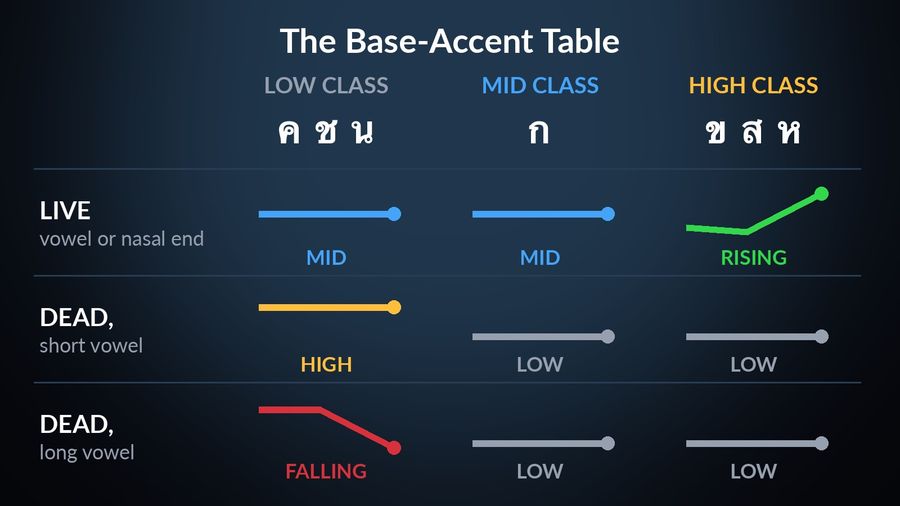
Start with a syllable that has no tone mark. Its tone, called the base accent, comes from nothing but its consonant's class and how the syllable ends:
| Unmarked syllable | Low class | Mid class | High class |
|---|---|---|---|
| Live (ends in a vowel or a nasal/semivowel sound) | mid | mid | rising |
| Dead, short vowel (ends in a stop sound, short vowel) | high | low | low |
| Dead, long vowel (ends in a stop sound, long vowel) | falling | low | low |
The app's number words show the pattern working. สอง (song, “two”) and สาม (sam, “three”) both start with the high-class ส and end in a live syllable with no tone mark, so both take the rising tone the table predicts. คุณ, the second syllable of ขอบคุณ (khop khun, “thank you”), starts with the low-class ค in a live, unmarked syllable, so it takes the mid tone. รัก, the second half of ความรัก (khwam rak, “love”), starts with the low-class ร but ends in the stop ก after a short vowel, a dead-short syllable, which the same table sends to the high tone instead.
Add a tone mark and the class still decides the outcome, just against a different part of the table. The two most common marks, mai ek (่) and mai tho (้), appear over letters of any class: mai ek gives a low tone on mid or high class letters and a falling tone on low class letters, while mai tho gives a falling tone on mid or high class letters and a high tone on low class letters. Two rarer marks, mai tri (๊) and mai chattawa (๋), are only ever written over mid-class letters, where they give the high and rising tones respectively (Wikipedia, Thai script). ไม่ (mai, “no”) and ใช่ (chai, “yes”) both start with a low-class letter (ม and ช) carrying mai ek, so both take the falling tone. น้ำ (nam, “water”) starts with the low-class น carrying mai tho, so it takes the high tone instead, and ห้า (ha, “five”) starts with the high-class ห carrying the same mark, which the table sends to falling.
One wrinkle is worth knowing before it confuses you. A handful of low-class letters, among them ง น ม and ย, have no high-class equivalent. To write those sounds under high-class tone rules, Thai puts a silent high-class ห in front of them; the pair is read as one syllable following high-class rules, with any tone mark carried on the visible low-class letter (Wikipedia, Thai script). หนึ่ง (nueng, “one”) is built this way: the silent ห turns the low-class น into a high-class syllable, which with the mai ek mark it carries gives the low tone.
The alphabet also keeps letters that sound identical today but come from different Sanskrit or Pali originals, preserved so that words borrowed from those languages, much of Thai's vocabulary for religion and formal register, kept their original spelling (Wikipedia, Thai script). That history is one reason two letters that sound alike can still belong to different classes and spell different tones.
Practical steps
- Learn the three class lists before the tone table. The table only tells you the tone once you already know whether a letter is low, mid or high, so that sorting has to come first, the same rote work as learning any list.
- Start with unmarked syllables. Most Thai syllables carry no tone mark at all, so the three-by-three base-accent table above covers more everyday words than the tone marks do.
- Add mai ek and mai tho next. They appear on letters of every class and cover the large majority of marked syllables; save mai tri and mai chattawa, which only ever sit on mid-class letters, for later.
- Read the Thai spelling for tone, not a plain romanisation. A romanised word like khop khun carries none of the tone information the Thai spelling ขอบคุณ does; treat the romanisation as a pronunciation aid for the consonants and vowels, and get the tone from the script.
- Check yourself against a recording. Working out a tone from the rules and then hearing whether you got it right is what turns the table above from arithmetic into something you recognise without thinking.
Thai is not the only script that puts information into the letters that English keeps separate: see how Devanagari spells Hindi almost exactly as it sounds in reading Devanagari before you speak Hindi, and how a different language builds meaning into pitch in Vietnamese tones without the panic. To see how many Thai words you already recognise, try the Thai vocabulary test, and for a rough timeline to your target level, the how long to learn Thai calculator.


Watch Your Language shows Thai vocabulary in Thai script with its romanisation next to it, ขอบคุณ beside khop khun, on your iPhone Lock Screen and Apple Watch face, a few words at a time, on a schedule built around the ones you keep forgetting. It will not teach you the tone rules themselves: it is a passive vocabulary tool, not a pronunciation course, so treat every glance as a chance to read the Thai spelling and work out the tone, rather than leaning on the plain romanisation beside it.